
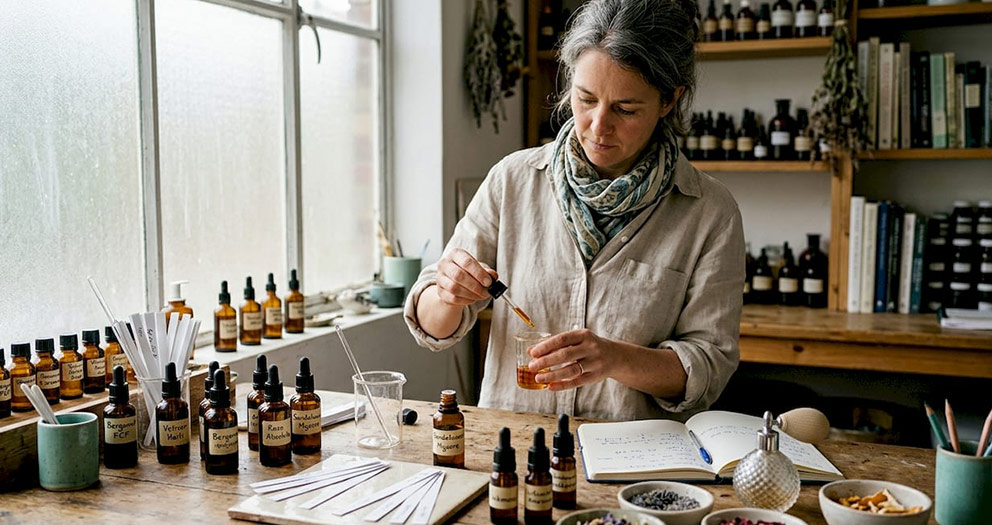
A fragrance formula is easier to develop when you know what it needs to do before you start mixing. Select materials with clear roles, set their proportions by weight, then test and revise the result. This framework is intended for early trials rather than as a fixed recipe.
Start with a brief
Write a short description of the scent you want to make. Include its general olfactive character, intended product and the impression it should create. A brief gives you a reference when deciding whether a material belongs in the formula. For example: “A warm, softly sweet amber fragrance for a body oil. It should stay close to the skin without a sharp citrus opening.” This is specific enough to guide material selection and evaluate the first trial.
Choose the end product and fragrance load
Fragrance load is the percentage of the complete fragrance concentrate in the finished product, calculated by weight. It is different from the percentage of each material within the concentrate. The ranges below can help frame early experiments. They are broad examples, not fixed formulation standards, IFRA limits or assurances of safe use.
| End product | Typical fragrance load |
| Parfum / Extrait | 20–40% |
| Eau de Parfum | 15–20% |
| Eau de Toilette | 8–15% |
| Eau de Cologne | 2–8% |
| Body oil (lightly fragranced) | 1–5% |
| Lotion or body cream | 0.5–2% |
| Soy candle | 6–10% |
| Reed diffuser | 15–30% |
| Room spray | 5–15% |
Fine-fragrance labels such as Eau de Parfum describe common market conventions, not a universal requirement for concentration. The body oil range refers to lightly fragranced body-care oils, not concentrated perfume oils or roll-on perfumes. Check the applicable IFRA Standards and other requirements for the intended product. Restricted materials must be assessed at their actual concentrations in the finished product, including restricted constituents contributed by other ingredients. A formula suitable for fine fragrance may need substantial changes for a leave-on cosmetic.
For candles, the wax supplier’s recommended fragrance capacity is only a starting point. Test the complete candle for wick performance, cold throw, hot throw and safe burning. A fragrance material’s flash point does not determine its ideal addition temperature or candle performance.
Choose a small set of materials
A formula may contain aroma molecules, essential oils, absolutes, resins or prepared accords. There is no requirement to use both natural and synthetic materials. Choose each material for a specific effect and consider how it behaves alongside the others. For a first trial, three to five materials are usually easier to evaluate than a long list. Natural materials and prepared accords can contain restricted constituents, so their composition and supplier information also matter when assessing compliance.
Use top, heart and base as a guide
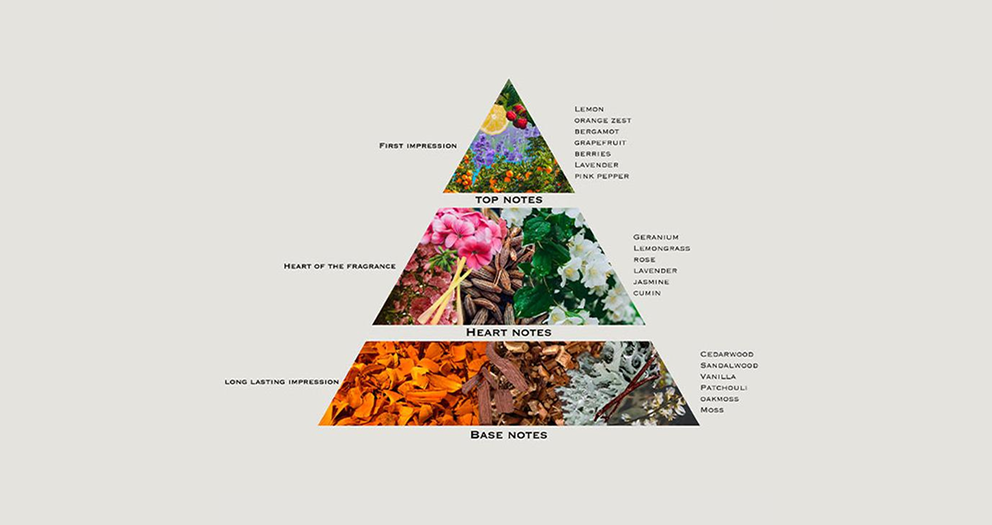
The fragrance pyramid helps describe how a scent changes over time, especially in fine fragrance. It is not a formula template or a requirement to allocate fixed percentages to each layer. Top notes shape the first impression. Highly volatile citrus materials and Dihydromyrcenol can strongly affect the opening. Heart notes carry much of the main character as the opening changes; floral, green and aromatic materials often contribute here. Base notes tend to last longer and give the dry-down continuity. Musks, woods, amber materials and resins can contribute to this stage.
Many ingredients play more than one role. Linalool has top and heart qualities. Iso E Super can support the base while remaining noticeable throughout the scent. Hedione can add transparent floral diffusion across several stages. Assigning a material to a single layer is a useful shorthand, not a precise description of its behaviour.
In candles and diffusers, these terms can still describe the smell, but release and performance depend on the finished base. They should not be judged as if the product were evaporating from skin.
Calculate the concentrate by weight
Every material, including solvents already present in supplied dilutions, must be included in the formula total. The finished concentrate adds up to 100% by weight. You can sketch in parts at first, but convert those parts to percentages before making a weighed trial.
For example, 1% of a 10 g concentrate is 0.10 g. If Ambroxan 10% IPM makes up 5% of that concentrate, you weigh 0.50 g of the supplied dilution. It contributes 0.05 g of active Ambroxan, or 0.5% of the concentrate; the other 0.45 g is IPM. The full 0.50 g counts towards the formula total. Use the same method for products such as Galaxolide 50% DPG, Coumarin 10% DPG or Vanillin 25% DPG. For IFRA and other compliance calculations, account for the actual concentrations of restricted constituents and the final fragrance load.
Make a trial, then revise it
Weigh a small batch and evaluate it on a scent strip. Record the opening, the impression after around 30 minutes and the later dry-down. Compare each stage with your brief. If something is too strong or missing, change one variable in the next version and keep the others unchanged. Use weight rather than drops for a reproducible formula. The amount delivered by a drop varies with the material and the dispensing method.
A practical example: building your first fragrance formula
Suppose your brief is to create a fresh, transparent woody musk with a clean opening, a soft floral character and a persistent musky drydown. Start with five materials and prepare a 10 g trial concentrate.
| Material | Formula (%) | Weight (g) | Role |
| Iso E Super | 35% | 3.50 | Woody structure |
| Hedione | 30% | 3.00 | Floral diffusion |
| Ethylene Brassylate | 20% | 2.00 | Soft musky foundation |
| Dihydromyrcenol | 10% | 1.00 | Fresh opening |
| Linalool | 5% | 0.50 | Floral freshness |
| Total | 100% | 10.00 |
Weigh each material into a clean glass vial using a scale with a resolution of at least 0.01 g. Mix thoroughly, label the vial and record the formula as Version 1. For initial olfactive evaluation, prepare a separate 10% dilution using 1 g of the concentrate and 9 g of perfumer’s alcohol. Evaluate it on a scent strip immediately, after 30 minutes, after two hours and again the following day.
Compare the result with your original brief. If the opening is too sharp, try reducing Dihydromyrcenol. If the composition feels too woody, adjust the balance between Iso E Super and Hedione. For example, if the opening is too sharp, your second trial could look like this:
| Material | Version 1 | Version 2 |
| Iso E Super | 35% | 35% |
| Hedione | 30% | 35% |
| Ethylene Brassylate | 20% | 20% |
| Dihydromyrcenol | 10% | 5% |
| Linalool | 5% | 5% |
| Total | 100% | 100% |
In this revision, five percentage points are transferred from Dihydromyrcenol to Hedione. The aim is to soften the opening while maintaining the woody and musky foundation. Prepare the second version separately and compare both under identical evaluation conditions. Keep the original trial for reference.
This illustrative formula has not been laboratory tested and is intended for scent strip evaluation. Before using it in a finished product, assess the applicable IFRA restrictions, material compatibility and product safety requirements.
Test in the intended application
A fragrance that works on a scent strip may behave differently in wax, a diffuser base, a room spray or a cosmetic product. Test the actual finished formulation at a suitable, compliant fragrance load. For candles, assess cold and hot throw together with complete burn performance. For reed diffusers, check clarity, diffusion and evaporation. For sprays and cosmetic bases, check solubility, compatibility, stability and any relevant classification or safety requirements. Changes in colour or odour over time should also be recorded.
Keep a usable formula record
Give each trial a version number and date. Record the material names, suppliers, supplied strengths, weights, percentages and any dilutions. Keep the evaluation notes and details of the finished-product test with the same record. That makes each trial reproducible and shows which change caused the next result. To put this process into practice, you can use The Lab, our dedicated fragrance formulation tool. We recommend using it alongside the practical example above as you develop and refine your own compositions.

Write a comment
Your email address will not be published. All fields are required