
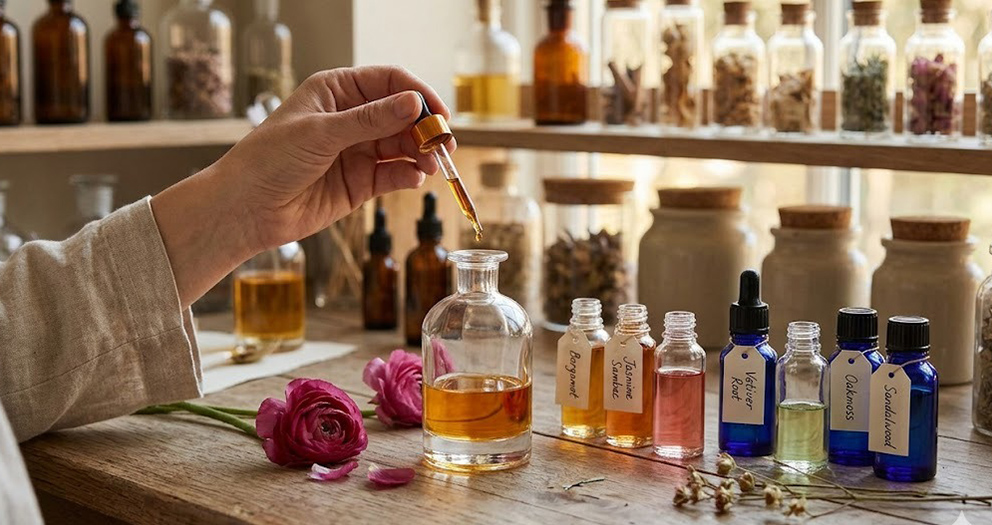
Picture this: a master perfumer in a sun-drenched atelier, surrounded by hundreds of tiny amber bottles. With practiced hands, they uncork a vial of fresh mandarin, add a few drops of real rose absolute, layer in some hand-harvested patchouli. A formula is born. Pure, natural, poetic.
It’s a beautiful image. But it’s mostly fiction.
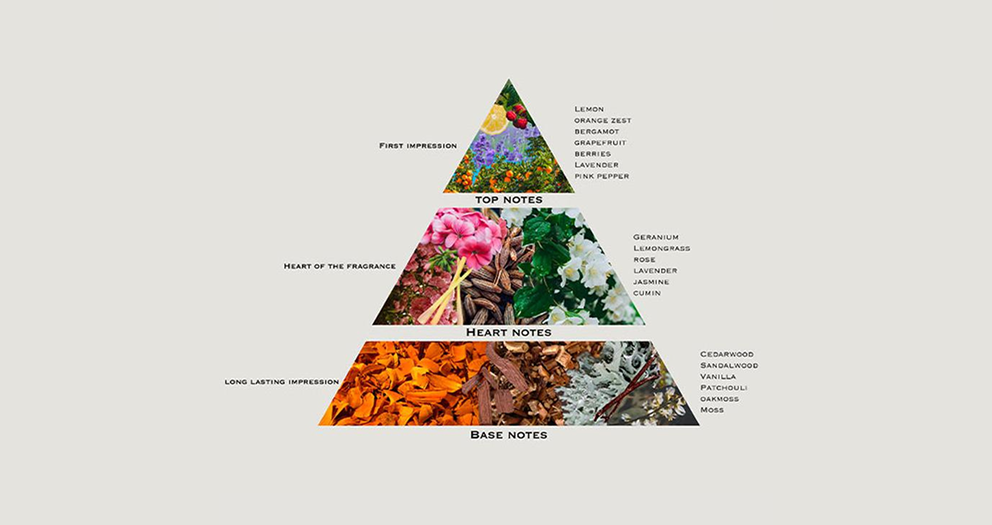
Not because perfumers aren’t skilled (they absolutely are!) but because the fragrance pyramid you read on a product page was never meant to be a formula. So what do fragrance notes mean, exactly? The short answer is that they describe the scent impression of a fragrance, not the ingredients used to create it. It’s a story told in a language designed for consumers, not chemists. And once you understand what’s actually behind it, you’ll never read a scent pyramid the same way again.
The Pyramid Was Never a Recipe
When a brand lists “cinnamon, rose, and sandalwood” as fragrance notes, they are not telling you what’s in the bottle. They’re telling you what the fragrance smells like. Or more precisely, what they want you to imagine it smells like.
The actual formula is a closely guarded trade secret. Fragrance houses are legally permitted to keep their formulas entirely proprietary, which means the ingredients list on most perfumes simply reads “parfum” or “fragrance.” Everything else: the pyramid, the note descriptions, the evocative language is a curated interpretation, a consumer-facing translation of something far more technical.
This isn’t deception exactly. It’s the industry’s way of communicating a sensory experience without revealing the chemistry behind it. But it creates a significant gap between what buyers think they’re reading and what’s actually happening in the bottle.
To make that gap concrete, consider a pyramid like this:
Top: Bergamot
Heart: Jasmine
Base: Amberwood
The actual formula behind it might contain Bergamot essential oil, Hedione, Linalool, Ambroxan, Iso E Super, Galaxolide, and a dozen other materials you won’t find mentioned anywhere on the label. The pyramid describes the impression. The formula creates it. They are two entirely different things.
What’s Actually in There: Aromachemicals (and Some Naturals)
The real building blocks of modern perfumery are Aromachemicals: isolated or synthesised molecules that carry specific scent characteristics. A fragrance formula is essentially a carefully calibrated blend of these molecules, designed by someone who understands both their chemical behaviour and their olfactory effect.
Natural ingredients do exist in perfumery, and in some high-end formulas they play an important role, like for example rose absolute, oud, natural sandalwood, labdanum etc. But even when naturals are used, they’re often chosen because they contain certain key molecules in useful concentrations. Nature is a starting point, not the whole story.
For the vast majority of commercial fragrances, and for most of the fragrance oils you’ll work with as a crafter, aromachemicals are doing the heavy lifting.
It’s also worth addressing a common assumption head-on: aromachemicals are not simply cheaper substitutes for natural ingredients. Many provide stability, consistency, safety, and scent effects that are difficult or impossible to achieve with natural materials alone. Some of the most beloved and iconic fragrance molecules don’t exist in nature at all!
The Teaching Shortcut: Note → Molecule
Here’s where things get genuinely useful for anyone learning to formulate. When you see a note name on a pyramid, you can start asking: what molecule, or group of molecules, is most likely creating that impression?
The table below gives you a starting framework. Treat it as a rough map, not a definitive legend. Real formulas rarely rely on a single molecule to create a note impression – a “rose” in a formula might involve four or five different aromachemicals working together, each contributing a different facet of the overall effect. But knowing the key players is how you start developing your nose for the underlying chemistry.
| Note (as listed) | Typical aromachemical(s) | Notes |
|---|---|---|
| Lemon / Citrus | Limonene, Citral | Limonene is one of the most common aroma molecules in existence |
| Grapefruit | Nootkatone, Citral, Limonene | Nootkatone gives that distinctive sharp grapefruit character |
| Mint | Menthol, Menthone | Menthol also carries a cooling effect beyond just scent |
| Cinnamon | Cinnamaldehyde, Cinnamic Alcohol | Cinnamaldehyde is potent, a little goes a long way |
| Clove | Eugenol | Also present naturally in many other spice and floral materials |
| Rose | Phenylethyl Alcohol, Geraniol, Citronellol, Rose Oxide | No single molecule. Rose is always a multi-molecule story |
| Jasmine | Hedione (Methyl Dihydrojasmonate), Indole, Benzyl Acetate | Indole is animalic at high doses; diffusive at low ones |
| Violet | Alpha-Isomethyl Ionone, Ionone | Ionones also add powdery depth to many accords |
| Lavender | Linalool, Linalyl Acetate | Linalool is also present in hundreds of other natural materials |
| Vanilla | Vanillin, Ethyl Vanillin, Coumarin | Coumarin adds a warm, hay-like facet common in oriental bases |
| Sandalwood | Javanol, Ebanol, Polysantol | Natural sandalwood exists but is expensive and restricted in supply |
| Patchouli | Patchouli Alcohol, Norpatchoulenol | Often used as a natural EO; the synthetic isolates are also common |
| Amber | Ambroxan, Labdanum-based accords | “Amber” is itself a constructed accord, not a single ingredient |
| Musk | Galaxolide, Habanolide, Ethylene Brassylate | Many structural types; each behaves differently in a formula |
| Woody / Cedar | Iso E Super, Cedramber | Iso E Super is famous for its diffusive, skin-like woody effect |
One note worth making explicit: “Amber” doesn’t exist in nature as a single ingredient. It’s an accord: A constructed blend that typically combines warm, resinous, and slightly animalic materials. When you see it on a pyramid, you’re seeing the impression of an accord, not a reference to any one raw material.
Perhaps the most striking illustration of this entire principle is lilac. It’s one of the most recognisable and widely used notes in perfumery, and yet real lilac flowers produce almost no commercially extractable essential oil. There is no “lilac” to bottle from nature. Every fragrance you’ve ever smelled that says “lilac” on the label is a reconstructed accord, built entirely from aromachemicals designed to evoke the flower’s character. The note exists. The natural source, for practical purposes, doesn’t.
If you’d like to explore how individual notes smell, behave, and are used in fragrance creation, our Scent Notes Library breaks down each one in detail.
Reading Pyramids With New Eyes
So the next time you read a fragrance pyramid, here’s the more accurate mental model:
The top, heart, and base structure describes evaporation stages, not ingredient categories. The note names are sensory shorthand chosen for consumer appeal, not technical accuracy. The formula itself is proprietary chemistry: a blend of aromachemicals (and occasionally naturals) that a trained formulator has calibrated to create a specific olfactory experience.
None of this makes fragrance less beautiful or creative. If anything, understanding the chemistry deepens the craft. Perfumery isn’t a garden, it’s a laboratory with an artistic brief. And knowing the molecules behind the notes is how you start working at that level yourself.
Understanding that fragrance notes are interpretations rather than ingredients doesn’t make them useless. Quite the opposite. Notes remain one of the most useful ways to describe a fragrance’s character and direction. They’re the vocabulary of the craft, even if the chemistry beneath them tells a different story.
If you’d like to explore the individual scent profiles behind common notes, how they smell, how they behave in a formula, and what aromachemicals typically create them, visit our Scent Notes Library, where we break each one down in detail.
Write a comment
Your email address will not be published. All fields are required