
Developing a fragrance blend is rarely a straight line. You start with an idea, combine several materials, adjust percentages, make a test, return to the formula, change it again and eventually arrive at something worth producing. During that process, however, you are doing much more than creating a scent. You are also making decisions that may affect IFRA compliance, classification, batch calculations and the suitability of the formula for its intended application. Until now, much of that information has lived across different documents, calculators, spreadsheets and handwritten notes. The Lab by Perfumedom is a free fragrance formulation tool created to bring that working process into one place.
Fragrance Formulation Should Be Easier to Understand
There are already formulation databases and calculators available online, but many approach formulation as a technical exercise made up of tables, numerical outputs and regulatory terminology. The information may be valuable, but interpreting what those numbers actually mean can require considerable technical knowledge.
We wanted to approach the problem differently. The Lab takes the formulation and regulatory data behind the materials and presents it through a more visual and intuitive workspace. It is designed for people actually developing candles, home fragrance, perfumes and other scented products, not exclusively for chemists or regulatory specialists.
The objective is not to simplify the underlying information until it becomes meaningless. It is to make useful technical information understandable enough to become part of everyday formulation work.
Build Formulas Using Perfumedom Materials
The Lab works directly with materials available from Perfumedom, including Fragrance Oils, Inspired Scents, Essential Oils and Aroma Molecules. You select the materials you want to use, enter their percentages and build the formula directly inside the application.
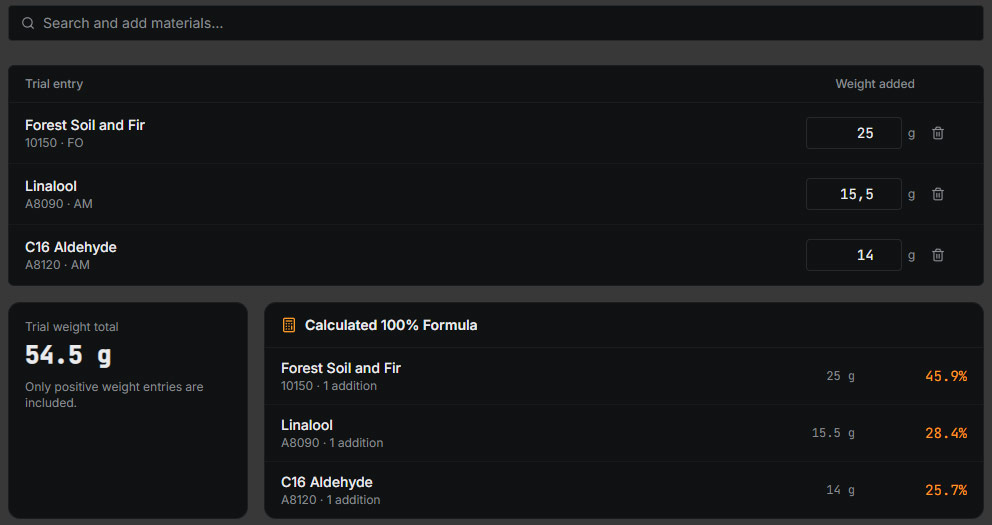
Because the fragrance formulation tool already contains technical information connected to those materials, the formula does not exist as an isolated list of percentages. As you continue working, the relevant material information remains connected to the composition.
This is particularly useful when formulas become more complex. Instead of repeatedly opening individual technical documents and manually comparing information, you can continue developing the composition from one central workspace.
Keep Every Stage of Your Experimentation
Real fragrance development involves repeated experimentation. A formula that seemed promising yesterday may need adjustment after testing, while an earlier version may suddenly prove better than the latest one.
The Lab allows different versions of a formula to be retained as it develops. This creates a structured history of the formulation instead of relying on notebooks, separate spreadsheets or multiple copies of almost identical files. That means you can experiment more freely without losing previous work and can return to earlier versions whenever necessary.
Understand the Olfactive Direction of Your Formula
The Fragrance Profile provides a visual representation of the olfactive character developing within your formula.
It does not attempt to formulate on your behalf and it does not replace sensory evaluation. Instead, it provides another way to understand the balance of the composition while you work. This becomes particularly valuable when several fragrance oils, essential oils and aroma molecules are combined and the overall character of the blend is no longer obvious simply by looking at a list of percentages.
Scale Experimental Formulas Into Working Batches
Once a formula begins to work, the Batch Calculator converts it into the quantities required for an actual test or production batch.
The same formula can be calculated for a small laboratory trial or scaled into a considerably larger batch without manually recalculating every material. The percentages remain unchanged while The Lab calculates the corresponding weights. This makes the transition from experimentation to production considerably simpler and reduces the risk of calculation mistakes when scaling a successful formula.
Check IFRA While You Are Still Formulating
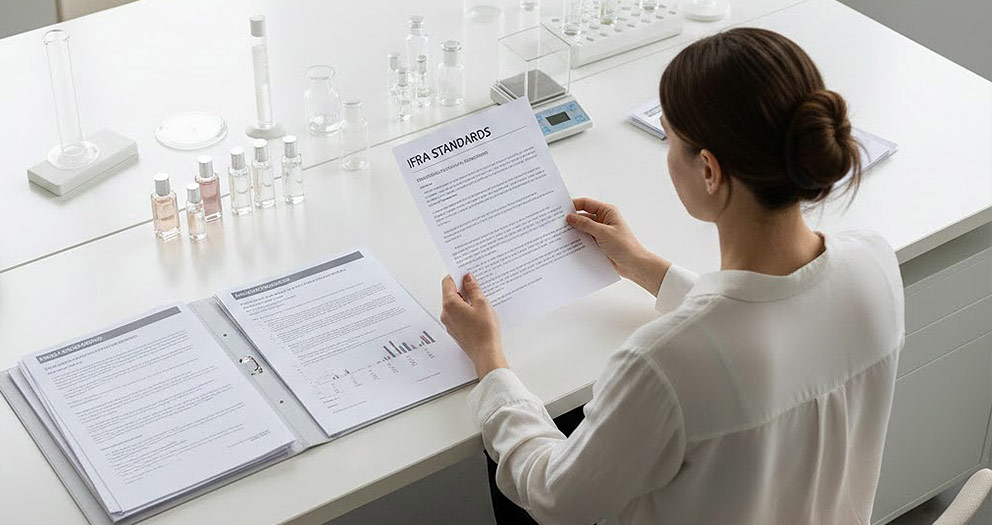
One of the most important features of The Lab is the IFRA Check.
A common workflow is to develop a complete blend and only afterwards start checking whether every material can actually be used at the chosen concentration for the intended application. By that point, significant development work may already have been completed.
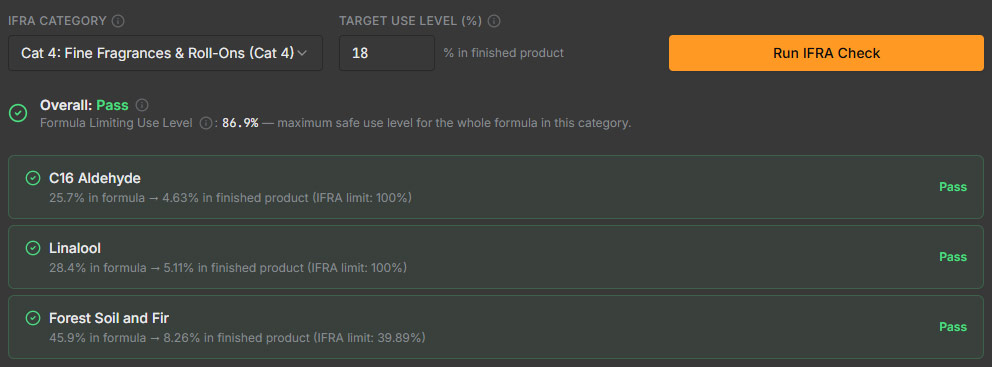
The Lab allows IFRA information to become part of the formulation process itself. You select the intended application and the fragrance formulation tool assesses the materials and concentrations against the available IFRA information.
If a percentage requires attention, it is considerably more useful to discover that while the formula is still being developed rather than after it has already been finalised.
Bring CLP Information Into the Development Stage
The CLP Check follows the same principle.
Individual Safety Data Sheets contain essential information, but once several materials are combined, the relevant question becomes what that combination may mean for the developing formula.
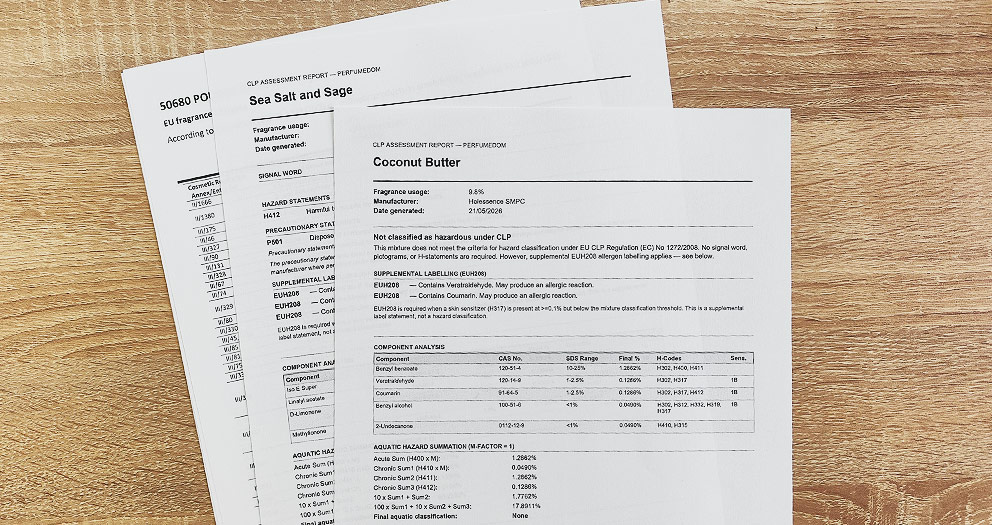
The Lab brings together the available CLP component information for supported materials and allows the combined formulation to be examined much earlier in the development process. It does not replace the legal obligations associated with placing a finished product on the market. Those responsibilities remain with the manufacturer. Instead, it gives the formulator much better visibility while changes are still easy to make.
Why We Built The Lab
Many regulatory services become involved only once a formula has been completed. You provide the finished blend, the percentages and the required information, and the necessary documentation can then be prepared.
That is an important part of bringing a product to market, but it does not solve the problems that arise during formulation itself.
How do you know whether a percentage you are currently testing is compatible with the relevant IFRA restrictions? How do you keep track of multiple experiments? How do you scale the successful version? How do you begin understanding the regulatory consequences of combining several materials before the formula is finished?
The Lab was built specifically to address that stage.
More Than Supplying the Raw Material
We believe supplying fragrance materials should involve more than providing a bottle together with an SDS, IFRA Certificate and Allergen Declaration.
Those documents remain essential, and they are available through Perfumedom’s Technical Documents resources. But our customers also need practical ways to understand the materials, experiment with them and use the information attached to them.
The Lab is part of a broader Perfumedom ecosystem that connects the materials we supply with formulation tools, technical documentation, CLP guidance and services such as SDS Workspace for later stages of product documentation.
Instead of leaving customers to assemble that workflow from unrelated tools, we are building the infrastructure around the materials ourselves.
A Free Fragrance Formulation Tool
The Lab is free to use.
There is no subscription required to access the formulation workspace and its core tools. Whether you are developing your first blend, creating signature fragrances for an established product range or managing numerous experimental formulas, the objective is the same: to provide a clearer, more organised and more informed way to formulate.
You can start working with The Lab at lab.perfumedom.com.

Observ ca nu e pot selecta uleiurile Scent Stash. E va putea e viitor?