

A practical guide to fragrance oil documentation, regulatory responsibilities, and the most commonly misunderstood certificate requests.
Table of Contents
There is a lot of confusion in the fragrance market about compliance documents. Buyers (from hobbyists to small manufacturers) often arrive with long lists of requests: certificates, declarations, approvals, and guarantees that either don’t exist in the form they imagine, or are simply not the supplier’s responsibility to produce.
This confusion is understandable. Fragrance regulation touches several overlapping frameworks (REACH, CLP, the EU Cosmetics Regulation, IFRA standards) and they don’t always speak the same language. Add to that a flood of AI-written supplier blogs that mix up terminology, and it’s no surprise that “do I need a CPSR or a CPNP?” becomes genuinely baffling.
This article explains what each document actually is, what it is for, and, critically, who is responsible for it. The goal is not to list requirements. The goal is to help you understand the logic, so you can make informed decisions for your specific situation.
The Safety Data Sheet (SDS)
The Safety Data Sheet is the foundational document for any chemical mixture. It is issued under Regulation (EC) No 1907/2006 (REACH), structured according to Regulation (EU) 2020/878, and the classification section follows Regulation (EC) No 1272/2008 (CLP).
An SDS communicates hazard information for the substance or mixture as supplied. It covers:
- Physical and chemical properties
- Hazard classification and labelling
- Handling, storage, and transportation guidance
- First aid and emergency procedures
- Regulatory status
What it is not: An SDS is not a certificate of safety. It is not an approval document. It is not evidence that a fragrance oil is “safe for” any specific application. It is a hazard communication tool, and it describes the material as a raw ingredient, not as an ingredient in your finished product.
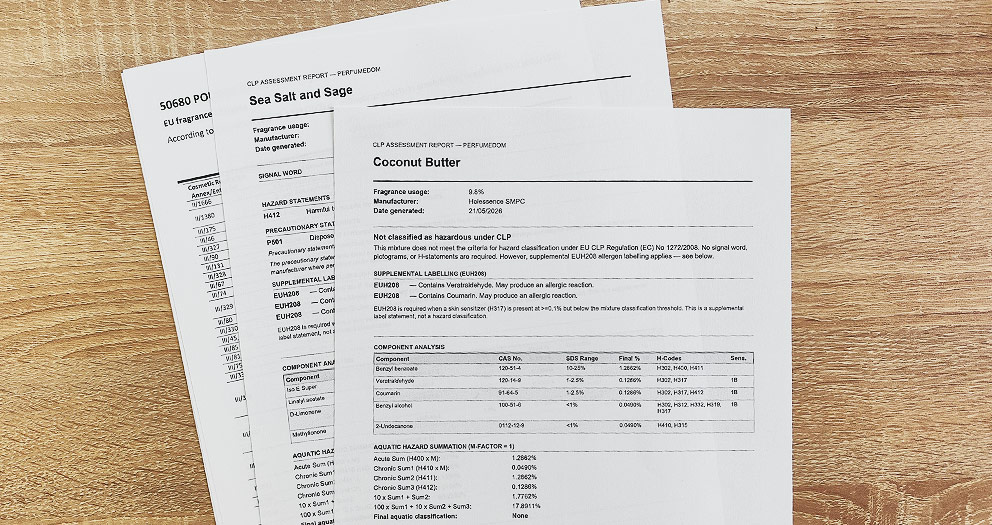
Who provides it: The supplier. If you purchase a fragrance oil from Perfumedom, we provide the SDS. This is a non-negotiable legal obligation under REACH.
What it doesn’t cover: The SDS does not tell you how to label your finished candle, cosmetic, or diffuser. It does not tell you what concentration is safe for skin contact. For that, you need different documents (described below).
The IFRA Certificate of Conformity
IFRA (the International Fragrance Association) publishes usage guidelines that set maximum concentration limits for fragrance materials across different product categories. These limits are based on safety assessments by the Research Institute for Fragrance Materials (RIFM) and are updated periodically through IFRA Amendments.
An IFRA Certificate of Conformity (sometimes called an IFRA compliance certificate) confirms that a specific fragrance oil has been assessed against the current IFRA Amendment and that usage at or below the declared limits in each category is considered compliant with IFRA standards.
The certificate is organised by usage categories; there are currently 12 in the latest amendment, covering everything from fine fragrances to rinse-off products, leave-on cosmetics, candles, and more. Each category has its own percentage limit.
What it is not: An IFRA certificate is not a formula approval. It is not a toxicology report. It is not a guarantee that your finished product is safe. That determination depends on the concentration at which you use the fragrance in your specific formulation, and it must be evaluated in the context of the full formula by a qualified person.
What you do with it: The limits stated in the IFRA certificate tell you the maximum usage level in each product category. If you are formulating a leave-on skin product and the IFRA limit for that category is 3%, you must not exceed 3% fragrance in your finished formula. This information feeds into your safety assessment; it does not replace it.
Who provides it: The supplier. We issue IFRA certificates for all fragrance oils we supply, in accordance with the current amendment.
The Allergen Declaration
Under EU Cosmetics Regulation 1223/2009, as amended by Delegated Regulation (EU) 2023/1545, fragrance allergens must be disclosed on product labels when present above certain concentration thresholds. The 2023 regulation significantly expanded the list of declarable allergens.
An allergen declaration from a fragrance supplier lists the regulated allergens present in the fragrance oil and their concentrations (as a percentage of the neat oil). This allows cosmetic manufacturers to determine which allergens will appear in their finished product at labelling-relevant levels.
What it is not: An allergen declaration is not a full composition disclosure. It does not reveal the complete formula of the fragrance. It covers only the allergens subject to mandatory declaration, because those are the ones that matter for your labelling obligations.
It is also not a safety guarantee. The presence of allergens on the list does not make a product unsafe, and their absence does not make it safe. Allergen disclosure is a transparency and labelling obligation, not a quality marker.
Who provides it: The supplier, specifically for cosmetic applications. We provide allergen declarations for all fragrance oils where this information is relevant.
Important: Allergen declarations apply to cosmetic products. If you are making candles, reed diffusers, or other non-cosmetic products, the cosmetic allergen framework does not directly apply, though CLP labelling obligations for the finished product may still be relevant.
CLP Classification and Labelling
Regulation (EC) No 1272/2008, known as CLP (Classification, Labelling and Packaging), governs how chemical substances and mixtures must be classified for hazards and labelled accordingly. This applies to the supply of chemical mixtures, including fragrance oils, and to finished products that qualify as chemical mixtures.
When a fragrance supplier provides an SDS, the CLP classification of the fragrance oil as supplied is included in that document. That classification reflects the neat fragrance oil.
What happens when you formulate: When you incorporate a fragrance oil into your own product (a candle, a room spray, a cosmetic) you create a new mixture. The CLP classification of that finished mixture is your responsibility. You must assess the hazards of your full formulation, assign a classification if applicable, and label accordingly.
This is where many small manufacturers get confused. They see that the fragrance oil has a CLP-classified SDS and assume that document covers their finished product. It does not. The SDS covers the raw material as supplied by the supplier. Your finished product requires its own assessment.
For mixtures supplied to the general public or professional users, CLP labelling obligations apply. For products supplied to professional users (B2B, not consumer retail), the requirements differ. This is a topic that merits its own dedicated post, but the key principle is that the finished product formulator is responsible for the CLP assessment and labelling of their own product.
The Big Distinction: What (we) the Supplier Provides vs. What (you) the Manufacturer Handles
Perfumedom supplies fragrance oils as raw materials for further formulation. We are not selling finished cosmetics, finished candles, or finished consumer goods. We are selling ingredients.
Within that context, here is a clear breakdown:
What Perfumedom provides:
- Safety Data Sheet: for the fragrance oil as supplied, in accordance with REACH
- IFRA Certificate of Conformity: confirming compliance with the current IFRA amendment across usage categories
- Allergen Declaration: for cosmetic use, listing declarable allergens as a percentage of the neat oil
- Certificate of Analysis: available on request, confirming physical and chemical batch parameters (appearance, specific gravity, refractive index, flash point, and similar).
These documents describe the raw material. They are issued for the ingredient, not for any finished product.
What the finished product manufacturer is responsible for:
- Cosmetic Product Safety Report (CPSR): required under EU Cosmetics Regulation 1223/2009 before placing a cosmetic product on the EU market. This must be commissioned by the manufacturer or Responsible Person and prepared by a qualified safety assessor.
- Final CLP classification and labelling of the finished product: the supplier’s SDS covers the raw material, not your formulation.
- UFI (Unique Formula Identifier) and PCN notification: required for hazardous mixtures supplied to consumers or professional users in the EU.
- Compatibility testing: for candle and diffuser applications, testing your fragrance in your specific base (wax type, wick size, vessel, carrier oil) is the manufacturer’s responsibility.
- Finished product labelling compliance: including cosmetic allergen labelling under the Cosmetics Regulation.
This distinction is not bureaucratic pedantry. It reflects the actual regulatory structure. The EU framework assigns responsibility based on who places the finished product on the market. That person is the manufacturer, whether they are a large cosmetic brand or a small craft candle maker selling on Etsy.
This distinction applies across the fragrance industry and is not specific to Perfumedom. Any fragrance oil supplier operating under EU chemical legislation works within the same framework.
For a more detailed breakdown of this topic, we have a dedicated article here: Supplier Obligations vs. Customer Responsibilities
Documents That Do Not Exist, or Do Not Apply to Fragrance Oils
This section exists because a significant number of customer enquiries request documents that are either not standard practice for fragrance oil suppliers, not applicable to this category of raw material, or based on a misunderstanding of how regulation actually works.
This is not a criticism of the people asking. Many of these requests originate from procurement checklists designed for entirely different product categories (food ingredients, pharmaceutical excipients, or finished cosmetic products) and have been applied to fragrance oils without adjustment. The result is a list of demands that ranges from “possible but not standard” to “this document does not exist in any regulatory framework anywhere.”
Below is a structured overview, grouped by the type of confusion involved.
Full composition disclosure
Requests of this type: full composition lists with INCI names, chemical names, CAS numbers, EC numbers, and percentage breakdowns of all ingredients.
Fragrance oil formulas are proprietary. The composition of a fragrance oil is a trade secret: it represents the intellectual property of the fragrance house that developed it. No fragrance supplier is obligated to disclose full compositional data to customers purchasing the oil as a raw material, and most will not do so under any circumstances.
What suppliers do provide is the information that regulation requires: the SDS (which covers hazard-relevant components above disclosure thresholds), the IFRA certificate (which covers safety-relevant usage limits), and the allergen declaration (which covers the specific substances subject to mandatory cosmetic labelling). These documents give you what you legally need. They do not give you the recipe.
If a safety assessor preparing your CPSR needs more detail, they may contact the fragrance supplier directly under confidentiality terms. That is a professional channel for professional purposes; it is not a standard customer document request.
Contaminant and substance-specific declarations
Requests of this type: statements on heavy metals, solvents, pesticides, PCBs, preservatives (including formaldehyde), PFAS, microplastics, nanomaterials, silver content (including colloidal silver), hexyl salicylate content, and sodium o-phenylphenol/sodium o-phenylphenate content.
This category of request comes in two varieties, and it is worth distinguishing them.
The first variety is reasonable in principle but not routine for fragrance oils. Contaminant declarations, PFAS statements, and similar documents exist in sectors where specific contamination risks are well-established: food, pharmaceuticals, certain cosmetic raw materials derived from natural sources. For synthetic or semi-synthetic fragrance ingredients, many of these substances are simply not present, not used in production, and not subject to sector-specific monitoring. A statement can sometimes be issued confirming absence, but this requires formulation-level knowledge that may not be available to the supplier if the oil is sourced from a fragrance house.
The second variety involves highly specific substance content requests (hexyl salicylate percentages, sodium o-phenylphenol content, colloidal silver levels) which presuppose a level of compositional transparency that fragrance suppliers do not provide for proprietary reasons (see above). If a specific substance is a genuine concern for your application, that concern should be raised with the fragrance supplier or house as a specific technical question, not as a document request from a standard list.
For microplastics: EU restrictions on intentionally added microplastics under REACH Annex XVII are relevant and ongoing. Where this applies to specific fragrance ingredients, it will be reflected in the SDS and regulatory update communications. It is not a separate standalone declaration document.
For nanomaterials: The EU Cosmetics Regulation requires disclosure of nanomaterial ingredients. Where a fragrance ingredient qualifies as a nanomaterial under the applicable definition, it would be disclosed in the regulatory documentation for cosmetic use. A blanket “nanomaterials statement” is not a standard supplier document.
CMR and safety-category declarations
Requests of this type: CMR statements (carcinogenic, mutagenic, or toxic for reproduction), non-toxic certificates, safe-for-use certificates.
CMR classification is part of the CLP framework. If a fragrance oil or any of its components meets the criteria for CMR classification under Regulation (EC) No 1272/2008, that classification is reflected in the SDS. CMR classification, where applicable, is reflected within the SDS. There is no separate document called a “CMR declaration” that supplements or replaces this; the classification is either present in the SDS or it is not.
A standalone “non-toxic certificate” does not exist in any recognised regulatory framework. Toxicity is not binary. Regulated documents assess specific hazard profiles under specific exposure conditions. “Non-toxic” is a marketing category, not a regulatory one, and no certifying body issues such certificates.
Similarly, “safe for candles” or “safe for cosmetics” certificates do not exist as supplier documents. Safety in application depends on the complete formulation, usage concentration, and intended consumer; none of which the fragrance supplier controls or can certify.
Origin, ethics, and lifestyle declarations
Requests of this type: non-animal testing statements, GMO declarations, vegan statements, BSE/TSE statements, country-of-origin declarations, ISO 16128 natural origin index declarations, halal statements, gluten content statements.
This group deserves a careful answer, because the requests are not unreasonable in themselves: they reflect genuine market needs, but the reality is more complicated than a simple yes/no document can capture.
Non-animal testing: Cosmetic ingredients sold in the EU cannot have been tested on animals for cosmetic purposes since 2013, under the EU Cosmetics Regulation. A declaration to this effect can be provided. However, it is worth noting that the underlying chemistry in fragrance oils may include substances that have been safety-assessed using historical animal data, data that pre-dates the ban and that underpins much of RIFM’s toxicological library. A “not tested on animals” declaration refers to new testing, not to the entire historical safety database. This distinction matters if the topic arises with end consumers.
Vegan and BSE/TSE: Many fragrance oils are entirely synthetic or derived from plant-based sources and genuinely have no animal-derived components. Where this is the case, a statement to that effect is straightforward. However, some fragrance ingredients (musks, certain fixatives, natural extracts) may have animal-derived components or processing aids. A blanket vegan declaration for all fragrance oils is not possible. Per-product enquiries are the appropriate route.
GMO: Fragrance oils are complex chemical mixtures, not food or agricultural commodities. EU GMO legislation (Regulation (EC) No 1829/2003 and 1830/2003) applies to food and feed and to deliberate release into the environment; it does not apply to synthetic chemical mixtures. A GMO declaration for a synthetic fragrance oil is conceptually inapplicable. For fragrance oils derived from natural botanical sources, the raw material provenance may be more complex, but even then, fragrance suppliers rarely hold GMO status documentation for upstream agricultural inputs.
ISO 16128 natural origin index: The ISO 16128 standard provides a methodology for calculating the natural origin index of cosmetic ingredients. It is a voluntary standard, not a regulatory requirement. Applying it to fragrance oils requires compositional data that suppliers do not disclose (see above). This is not a document that fragrance suppliers standardly produce.
Halal certification: Halal status is a third-party certification issued by recognised certification bodies, not a supplier declaration. If halal-certified fragrance oils are a requirement, this needs to be specified at the point of sourcing; it is a procurement constraint, not a documentation request that can be retrofitted after purchase.
Gluten content: Gluten is a protein complex found in wheat, barley, rye, and related grains. It has no presence in synthetic fragrance chemistry and no relevance to fragrance oil regulation under any EU framework. This request has almost certainly been copied from a food or nutraceutical procurement checklist without review.
Certificate of Conformity (CoC)
Requests of this type: “Certificate of Conformity,” “CoC,” sometimes described as a document confirming the product meets quality or regulatory standards.
This one is consistently misunderstood, because “Certificate of Conformity” is not a standardised document with a fixed definition in fragrance regulation. It means different things depending on who is using the term.
In practice, when customers request a CoC for a fragrance oil, they usually mean one of three things they already have: the IFRA Certificate of Conformity (which is literally named that, and is covered in detail above), the Certificate of Analysis (a batch-specific document confirming the product meets its physical and chemical specification), or a general quality declaration of some kind.
No EU regulation (not REACH, not CLP, not the Cosmetics Regulation) mandates that a fragrance oil supplier issue a document specifically called a Certificate of Conformity. Some suppliers produce one voluntarily as part of a quality management system, in which case its content typically often overlaps substantially with the information already covered by a CoA.
If you have been asked to provide a CoC to someone downstream, or if you are requesting one from a supplier, the most useful question to ask is: what specifically should this document confirm? In most cases, the answer points toward documentation that already exists under a more specific and technically accurate name.
Manufacturing process and supply chain declarations
Requests of this type: GMP certificates or statements, EUDR due diligence statements, TDS with microbiological purity parameters and test methods.
GMP (Good Manufacturing Practice): GMP standards (such as ISO 22716 for cosmetics) apply to the manufacture of finished cosmetic products. They are not a standard certification requirement for fragrance oil suppliers operating under chemical industry regulations. Some larger fragrance houses may hold ISO 9001 quality management certification or similar. Whether a specific supplier holds GMP or equivalent certification is a supplier qualification matter to clarify at the point of onboarding, but it is a supplier qualification question, not a standard document that every fragrance supplier issues as a matter of course.
EUDR (EU Deforestation Regulation): The EUDR (Regulation (EU) 2023/1115) applies to specific commodities (cattle, cocoa, coffee, palm oil, soya, wood, rubber, and derived products) that carry deforestation risk. It requires due diligence statements from operators placing these commodities on the EU market. Fragrance oils do not fall within the listed commodity categories. Fragrance oils as a product category are not subject to EUDR due diligence obligations.
TDS with microbiological parameters: A Technical Data Sheet (TDS) or product specification sheet can be provided for fragrance oils and typically covers physical and chemical parameters: appearance, colour, odour, specific gravity, refractive index, flash point, and similar. Microbiological purity parameters (total viable count, yeast and mould counts, absence of pathogens) are relevant for products with water activity that supports microbial growth. Fragrance oils are anhydrous (water-free) or near-anhydrous chemical mixtures. Microbial growth is not a relevant risk profile for this material category, and microbiological testing is not standard practice for fragrance oils. Requesting microbiological limits and test methods for an anhydrous fragrance oil suggests this specification has been copied from a cosmetic emulsion or aqueous raw material context and applied incorrectly.
The underlying pattern
Most of these requests share a common origin: a compliance checklist designed for a different product category (food ingredients, pharmaceutical raw materials, finished cosmetic products, or agricultural commodities) that has been applied to fragrance oils without adaptation.
This is understandable. Procurement processes are often templated, and compliance requirements across the broader industry are genuinely increasing. The problem is that fragrance oils occupy a specific regulatory niche (complex proprietary chemical mixtures supplied as raw materials under the REACH and CLP frameworks), and many of the documents on these lists either do not apply, cannot be issued without disclosing proprietary formulation data, or address risks that are simply not relevant to this material type.
The documents Perfumedom provides (SDS, IFRA certificate, allergen declaration, and Certificate of Analysis) represent what is standard, meaningful, and appropriate for this category. If there is a specific concern about a specific substance or application, the right approach is a targeted technical question, not a 20-item checklist.
A Note on the Difference Between IFRA, CLP, and Allergen Frameworks
Because these three often get conflated:
IFRA sets usage limits based on safety assessments by RIFM. It is an industry standard, not a legal regulation, but it is widely referenced in legal safety assessments (CPSRs) as the basis for determining safe usage levels in cosmetics and other product categories.
CLP is EU law. It governs hazard classification and labelling of chemical substances and mixtures. It applies to the supply of chemicals and to finished products that are chemical mixtures. It is about communicating hazards, not approving safety.
Allergen disclosure under the EU Cosmetics Regulation is specifically about transparency to consumers: it requires labelling of certain fragrance allergens above threshold concentrations. It is separate from both the IFRA framework and CLP, though it draws on similar underlying chemistry.
These three frameworks address different questions. IFRA: is this fragrance used at a safe level for a given application? CLP: how should this mixture be classified and labelled for hazard communication? Allergen regulation: which allergens must be declared on the finished cosmetic label?
Understanding which question you are trying to answer will usually point you to the right document.
Summary
| Document | Provided by | Purpose | Covers finished product? |
|---|---|---|---|
| SDS | Supplier | Hazard communication for the raw material | No |
| IFRA Certificate | Supplier | Usage limits by product category | No (gives limits, not approval) |
| Allergen Declaration | Supplier | Cosmetic allergen disclosure data | No (covers neat oil) |
| Certificate of Analysis | Supplier | Batch conformity | No |
| CPSR | Manufacturer | Cosmetic product safety, required for EU market | Yes (finished product only) |
| CLP classification of finished product | Manufacturer | Hazard classification of the formulation | Yes |
| UFI / PCN notification | Manufacturer | Poison centre notification for hazardous mixtures | Yes |
If you have received all four supplier documents (SDS, IFRA, allergen declaration, and CoA) you have what the fragrance supplier is responsible for providing. Everything beyond the raw material documentation relates to the finished product and its intended use.
This is not a burden placed on you arbitrarily. It is a logical structure: the person who knows the full formulation, the intended application, and the end consumer is the person best placed, and legally required, to carry out the finished product safety obligations.
If you are unsure where to start with any of the manufacturer-side obligations, the right starting point is a qualified safety assessor for cosmetics, or the relevant regulatory guidance from your national authority.
Looking for product-specific SDS, IFRA, and allergen documents? These are available in our Documents Library or directly within the “Related Documents” tab on each fragrance oil product page.



Unde pot vedea documentatia pentru parfumurile din setul de toamna – iarna?