

Table of Contents
In a well-known sensory study, researchers gave 54 wine tasters a white wine that had been coloured red with an odourless dye. The wine had not suddenly acquired the chemistry of a red wine. Only its appearance had changed. Yet when the tasters were asked to describe its aroma, they began using descriptors normally associated with red wine. The visual information had influenced the way they interpreted what they were smelling. PubMed
Other controlled experiments have produced similar results. Colour can influence perceived odour intensity even when the odorous material itself has not changed. PubMed
This is an important place to begin any discussion about fragrance oil discoloration.
Put two bottles of the same fragrance in front of someone (one pale yellow and one deep amber) and it becomes remarkably difficult to evaluate them without expectation. The darker one looks older. The brain expects it to smell heavier, weaker, different or somehow “less fresh”.
Sometimes there really has been a chemical change. Sometimes there has not. And that distinction is exactly what this article is about.
What is fragrance oil discoloration?
Fragrance oil discoloration simply means that the colour of a fragrance concentrate, or of a finished product containing that fragrance, changes with time or under particular conditions.
A colourless fragrance may become pale yellow. Yellow may become amber. Amber may become brown. A white candle may slowly become cream or yellow. A soap containing a vanilla fragrance may eventually become dark brown. The important point is that discoloration is an observation, not a diagnosis.
It tells us that the optical properties of the mixture have changed. It does not, by itself, tell us why.
A colour change may result from:
- oxidation of susceptible fragrance materials;
- reactions involving vanillin, ethyl vanillin or other reactive aromatic materials;
- exposure to light;
- elevated temperature;
- reactions with a finished-product base, particularly under extreme pH;
- naturally coloured raw materials;
- normal variation between production lots;
- gradual ageing of the fragrance mixture.
These mechanisms are not equivalent. This is why “it has become darker” and “it has degraded” should never automatically be treated as the same statement.
Is fragrance oil discoloration the same thing as oxidation?
No. Oxidation is one possible cause of fragrance oil discoloration, but discoloration and oxidation are not synonyms.
Many fragrance molecules contain chemical structures that can react with oxygen over time. Linalool and limonene are good examples. Research has demonstrated that both can undergo autoxidation after exposure to air, producing hydroperoxides and other oxidation products. PubMed
IFRA specifically addresses this issue for linalool. Its Standard recommends keeping peroxide levels as low as practical and notes that antioxidants can be added during production of the raw material to help control oxidation. IFRA That is genuine chemical degradation. And when oxidation progresses sufficiently, it can also change the smell.
Researchers studying oxidising limonene and linalool found that citrus notes gradually diminished while woody, acidic and heavier notes became more prominent. ScienceDirect
Commercial orange oils exposed to oxygen for several months have also demonstrated measurable losses of important aroma molecules alongside increased oxidation products and changes in sensory character. ScienceDirect So yes: oxidation can change colour, composition and odour. But the reverse statement does not follow.
A fragrance becoming darker does not prove that meaningful oxidative degradation has occurred.
That difference is fundamental.
The molecules most commonly associated with discoloration
There is no single “discoloration molecule”, because fragrances may contain dozens or hundreds of materials. However, several groups deserve particular attention.
Vanillin and Ethyl Vanillin
Vanillin is probably the best-known cause of fragrance-related browning. It provides the familiar sweet vanilla character used across gourmand, amber, creamy, bakery and oriental fragrances. It is also notorious among soap and candle makers for colour development.
Commercial testing repeatedly shows that fragrances containing vanillin can produce yellow, tan or dark brown finished products. In soy wax, higher-vanillin and some citrus-containing fragrances can produce visible yellowing within as little as 24 hours, while lower levels may produce slower changes. CandleScience
Ethyl vanillin can behave similarly. Controlled soap examples in the patent literature have shown ethyl-vanillin-containing soap becoming distinctly brown during stability testing. data.epo.org
Neither observation means that vanillin-containing fragrances are poor quality. It means that vanillin chemistry needs to be considered when colour matters.
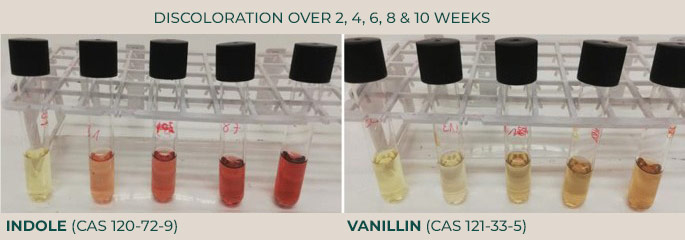
Limonene, linalool and other oxidation-sensitive terpenes
Limonene, indole and linalool are widely used fragrance materials and also occur naturally in many essential oils. They can oxidise during storage after exposure to atmospheric oxygen. Their oxidation chemistry is important not only because of fragrance stability but also because some oxidation products have greater sensitisation potential than the original materials. PubMed
Light and elevated temperature can substantially accelerate changes in terpene-rich oils. In a study examining lavender, pine, rosemary and thyme oils for up to 72 weeks, the extent of chemical change varied considerably according to temperature and light exposure. ScienceDirect Again, however, terpene oxidation does not necessarily present itself as dramatic brown discoloration. Colour is only one possible symptom of chemical ageing.
Citrus, cinnamon and some floral materials
Finished-product testing also shows that citrus oils, cinnamon-related components and some floral fragrances can influence colour even where vanillin is not the only relevant component. CandleScience Support This is why looking only for the word “vanillin” does not provide a complete discoloration assessment.
How quickly does fragrance oil discoloration happen?
There is no universal answer. Claims such as “a fragrance oil should remain the same colour for twelve months” are not scientifically meaningful unless the particular fragrance, packaging and storage conditions have been defined. Depending on the system, visible fragrance oil discoloration can occur:
- within hours or days;
- over several weeks;
- gradually over months;
- or only after prolonged storage.
In soy wax, some high-risk fragrances can produce visible yellowing within 24 hours. In cold-process soap, the development may continue throughout curing. One commercial example containing 2.01–5% vanillin changed during production and developed a deep brown colour after 30 days. CandleScience
In neat aromatic materials and essential oils, the process can occur much more gradually.
Commercial orange oils exposed to oxygen at room temperature were studied for up to three months and demonstrated measurable chemical and sensory changes. Another study followed essential oils for as long as 72 weeks and found that their stability differed considerably according to the oil itself and the conditions in which it was stored. ScienceDirect
This is why a date alone tells us very little. The meaningful variables are composition + oxygen + temperature + light + packaging + application.
What does storage have to do with it?
Quite a lot. Oxygen, light and temperature are among the major variables involved in fragrance-material stability. For oxidation-sensitive materials, higher temperature generally increases reaction rates. Light can initiate or accelerate photochemical processes. Oxygen availability obviously affects oxidation.
This is not theoretical. Research comparing essential oils stored under different light and temperature regimes demonstrated markedly different degradation profiles. ScienceDirect
For fragrance concentrates, sensible storage therefore means:
- keeping containers tightly closed;
- avoiding unnecessary exposure to light;
- avoiding prolonged elevated temperatures;
- limiting repeated unnecessary opening;
- avoiding excessive headspace where practical;
- using packaging appropriate for the material.
The product-specific SDS should always take precedence over generic storage advice. For example, the SDS for our Velvet Cream Peony fragrance initially describes the material as colourless to slightly yellow. The same SDS explicitly instructs users to keep the container tightly closed, protect it from extreme temperatures and light, and states plainly:
“The product may discolor due to prolonged storage.”
That distinction matters. The manufacturer itself recognises colour development as an expected possible behaviour of that formulation.
Why your previous bottle is not necessarily a colour specification
This is where misunderstandings often begin. Imagine purchasing 100 g of a fragrance in January. It arrives pale yellow. Six months later, you purchase another 100 g. The new bottle is amber. It is tempting to conclude: “My previous bottle was yellow. This one is brown. Something must be wrong with this one.”
But that conclusion skips several possibilities.
The two quantities may have been filled at different points in the commercial life of the fragrance. They may originate from different manufacturing lots. Raw-material colour can vary. And most importantly, the fragrance itself may have a known inherent tendency to change colour.
Your previous bottle therefore represents the appearance of that particular material at that particular moment. It is not automatically a permanent colour specification against which every future purchase can be judged.
That does not mean suppliers should dismiss unexpected changes. It means colour has to be interpreted in the context of the chemistry of the product.
This is why every Perfumedom product page includes a Discoloration Assessment
Rather than leaving customers to infer stability from the colour of the bottle they happened to receive, the assessment examines the formulation data available to us and explains:
- whether the fragrance has a meaningful discoloration tendency;
- what level of discoloration may reasonably be expected;
- which components are likely to drive it;
- and why those components can produce colour development.
The purpose is not to predict the exact shade that a fragrance will have six or twelve months from now. That would not be technically credible. The purpose is to tell you whether fragrance oil discoloration is an inherent characteristic that should be expected when selecting that material.
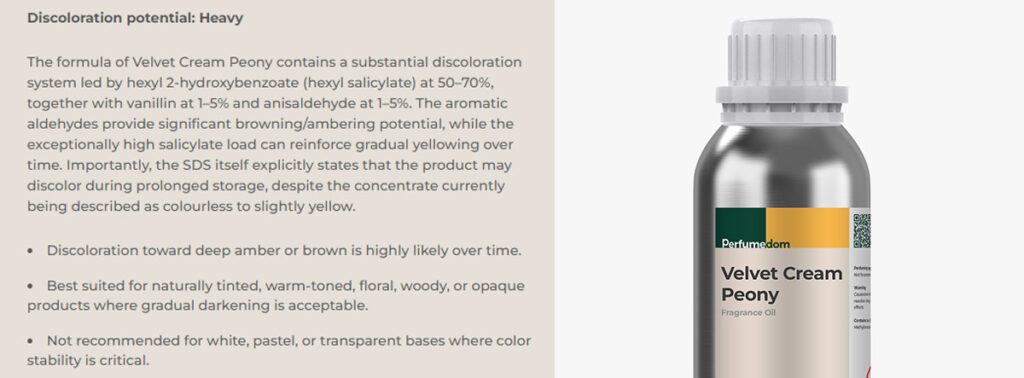
This should therefore be the first thing you check when comparing the colour of a new bottle with an older purchase.
If the product’s Discoloration Assessment identifies the fragrance as strongly discoloration-prone, an older pale-yellow bottle and a newer amber bottle can simply represent different points along an expected ageing pathway.
A darker appearance alone is not evidence that the newer bottle has “gone bad”. Conversely, if a fragrance is assessed as having very low discoloration potential and suddenly displays an extreme unexplained colour change, that deserves closer investigation. The assessment is therefore a tool for interpreting colour, not an excuse to ignore genuine quality problems.
Does a darker fragrance oil perform worse?
Not necessarily. And this is probably the most important practical point in this article. Commercial candle guidance specifically distinguishes fragrance-induced colour change from fragrance or burn performance. CandleScience, for example, notes that components including vanillin, citrus oils, cinnamon and certain floral materials can change the appearance of wax without indicating a performance problem. CandleScience Support
Vanillin content is therefore primarily a useful indicator of discoloration potential, not scent strength. At the same time, advanced oxidation really can change an aroma. In controlled oxidation studies of limonene and linalool, fresh citrus notes decreased while heavier sensory characteristics developed. ScienceDirect
Both things can therefore be true: A fragrance can darken while continuing to perform perfectly well. And: A fragrance can undergo sufficient chemical degradation to change its odour and performance.
Colour alone cannot tell you which situation you have.
So how can you tell whether a fragrance has actually deteriorated?
Look for multiple pieces of evidence. A gradual colour shift by itself is weak evidence. More meaningful warning signs include:
- a clearly new or abnormal off-odour;
- loss or substantial alteration of the original fragrance character;
- unexpected phase separation;
- persistent haze where the product should normally be clear;
- abnormal sediment or precipitation that cannot be explained by normal crystallisation;
- substantial viscosity change;
- container or closure damage;
- measurable deterioration in the intended finished application.
The more of these signs appear together, the more reasonable it becomes to investigate degradation rather than simple discoloration.
And evaluate smell blind where possible
If you genuinely want to compare an older and newer sample, hide the colour. Put them into identical opaque containers or otherwise prevent the evaluator from seeing the liquid. Then smell A and B. This matters because sensory research demonstrates that visual colour can change how odours are perceived and described. PubMed
Better still, test both samples in the product you actually manufacture.
For a candle, compare the finished candles. For a reed diffuser, compare diffusion. For soap, compare the cured product. The raw fragrance bottle is a raw material. It is not the finished application.
Can a stabilizer be added to the fragrance oil itself?
Yes… but with an important qualification. An antioxidant may slow future oxidation. It does not reverse chemistry that has already occurred, and it does not bleach an already dark fragrance back to its original colour.
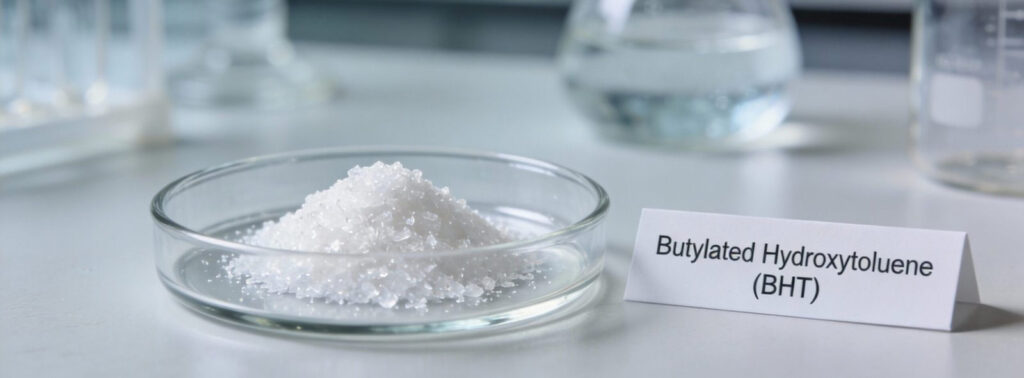
One familiar example is BHT.
In its specification for linalool, IFRA notes that addition of 0.1% BHT or α-tocopherol has shown good effectiveness in reducing peroxide formation. This recommendation concerns oxidation management of linalool-rich material; it should not be misread as a universal 0.1% formula for every fragrance oil. IFRA
Purpose-designed commercial fragrance stabilizers also exist.
BASF’s Tinogard TS, for example, is an oil-soluble phenolic antioxidant intended for oxidation-sensitive systems. BASF states that it can be added to the oil, perfume or organic phase and describes it as non-discolouring and odourless. Typical levels of 0.01–0.10% are cited, although BASF explicitly notes that the optimal level depends on the individual formulation, packaging and required long-term stability.
BASF also offers other antioxidant systems such as Tinogard TT and Tinogard DA for oils and fragrances. Care360 However, this is where makers need to resist the temptation to treat additives as universal recipes. If you add BHT, tocopherol, Tinogard or another stabilizer to a fragrance oil you purchased, you have modified the supplied mixture.
Compatibility, concentration, solubility, regulatory impact and suitability for the intended finished product need to be considered. The technically preferable approach is therefore:
- store the fragrance correctly;
- ask whether the fragrance manufacturer already uses antioxidant protection;
- where necessary, carry out a controlled stability trial;
- only modify the fragrance concentrate when you understand the consequences.
What can be added to the finished product?
That depends entirely on why the finished product is discoloring. There is no universal “anti-discoloration additive”.
If oxidation is the problem
An appropriate antioxidant can sometimes improve stability. Products such as Tinogard TS or TT are designed to protect oxidation-sensitive oils and fragrance components. Care360 Selection and dosage, however, need to match the formulation.
If light is the problem
A UV/light stabilizer may be more appropriate. BASF, for example, describes Tinogard TL as a broadband UV stabilizer intended to protect fragrances, colours and other sensitive materials against photolytic and photo-oxidative degradation in transparent packaging. Shop@BASF
Tinogard Q uses a different mechanism and is intended to reduce light-induced degradation, particularly in combination with suitable UV absorbers. Care360
If a candle is yellowing from light
Purpose-designed candle UV inhibitors can help reduce yellowing and fading caused by sunlight or artificial light. But this distinction is critical: a UV inhibitor does not necessarily stop vanillin-driven discoloration.
CandleScience explicitly warns that yellowing from vanillin is a separate phenomenon and is not prevented simply by adding a UV inhibitor. CandleScience
If soap is browning because of vanilla materials
Vanilla/vanillin colour stabilizers exist specifically for some soap and body-product applications. They can delay or reduce colour development, but they should be chosen for the specific application. A product suitable for melt-and-pour soap is not automatically suitable for cold-process soap, cosmetics, candles or another system.
Commercial soap guidance also makes clear that such stabilizers may help reduce vanillin-related browning, rather than somehow changing the fact that the fragrance itself has discoloration potential.
In all cases: stabilisation should target the mechanism that is actually causing the instability. Adding an antioxidant to solve a UV problem, or a UV absorber to solve vanillin chemistry, is unlikely to produce the result you expect.
Can you stop fragrance oil discoloration completely?
Sometimes it can be greatly reduced, while sometimes it can be delayed. Sometimes the sensible answer is simply no. If a fragrance has a strong inherent tendency to discolor in the intended formulation, formulation design may be more realistic than trying to fight the chemistry indefinitely.
That may mean:
- choosing a lower-discoloration fragrance;
- choosing a vanillin-free alternative;
- using colour deliberately in the finished product;
- using opaque or UV-protective packaging;
- reducing unnecessary light and heat exposure;
- selecting an appropriate antioxidant or stabilizer;
- testing before committing to a large production run.
What it should not mean is assuming that every fragrance can remain water-clear forever if the supplier simply stores it “properly enough”. Chemistry does not work that way.
Realistic expectations from a fragrance supplier
There is an uncomfortable but important commercial reality behind all of this.
When you buy fragrance oil in 10 g, 50 g or 100 g quantities, you are buying retail access to materials that normally exist further upstream in much larger production drums.
That flexibility has value.
It allows a small maker to test 20 fragrances instead of committing to twenty industrial containers. It allows businesses to carry broad scent catalogues without purchasing kilograms of every fragrance before knowing what will sell.
But flexible retail supply also means that not every 100 g bottle can reasonably be expected to represent fragrance collected immediately after the manufacturer’s production vessel was filled.
A distributor has to balance freshness, stock availability, price, range and flexible pack sizes.
That does not lower the obligation to supply good material.
A supplier must store products appropriately. Products need to be correctly identified. Documentation needs to remain valid. Genuine signs of degradation need to be taken seriously. But there is a difference between a legitimate quality problem and expecting an inherently discoloration-prone fragrance to remain permanently at its original manufacturing colour.
If your production process depends on a fragrance having an extremely narrow visual specification, small repeated retail purchases may simply be the wrong purchasing model.
Ask for larger quantities from a single production lot. If necessary, purchase 5 kg or more rather than repeatedly buying 100 g and expecting each small purchase made months apart to look visually identical.
That gives you much greater batch consistency. And even then, it is important to understand one final point:
buying the fragrance when it is pale does not stop it from becoming darker later.
If the formulation has an inherent tendency to discolor, the same chemistry can continue after the bottle arrives in your workshop and after the fragrance is incorporated into your product. Buying fresher material resets the starting point. It does not abolish the process.
“But my previous bottle was yellow and this one is brown.”
This is precisely why we provide a Discoloration Assessment on every fragrance oil product page!
Before concluding that a fragrance has deteriorated, check it.
If the assessment explains that the blend contains materials associated with substantial colour development, a difference between an older purchase and a newer purchase must be interpreted in that context. The colour of your previous bottle is not automatically a reference specification for every future batch.
A useful way of thinking about it is this: If a fragrance was yellow at Month 1 and normally develops towards amber or brown with time, receiving it at Month 5 instead of Month 1 does not necessarily mean you have received an inferior fragrance.
You may simply be looking at the same expected chemical ageing pathway at a later point.
The relevant question is whether the material remains within its expected behaviour and fit for its intended use. If it smells materially wrong, behaves abnormally, separates, develops unexplained contamination or fails in application, contact us.
If it has simply moved from yellow to amber exactly as its Discoloration Assessment says it may, colour alone is not evidence of failure.
The practical checklist
When you notice fragrance oil discoloration:
1. Check the product’s Discoloration Assessment.
Was colour change already identified as expected? Which ingredients are driving it?
2. Check the storage history.
Has the fragrance been exposed to prolonged heat, light, air or unsuitable packaging?
3. Look beyond colour.
Check odour, clarity, phase stability, viscosity and any unexpected sediment.
4. Compare blind.
Do not allow a darker colour to tell your nose what it is supposed to smell.
5. Test in the intended application.
Compare actual candle, diffuser, soap or spray performance.
6. Stabilise the correct mechanism.
Antioxidants address oxidation. UV stabilizers address light-driven degradation. Vanillin colour stabilizers target specific formulation problems.
7. Test any additive before adopting it.
A stabilizer is another formulation ingredient, not magic powder.
8. If strict visual consistency matters commercially, buy accordingly.
A larger quantity from one lot is a much more realistic way to achieve batch-to-batch visual consistency than buying multiple small packs months apart.
Discoloration does not mean “anything goes”
None of the above should be interpreted as an excuse for supplying genuinely degraded fragrance oil. That is not the point. Fragrance discoloration needs to be evaluated rationally, not dismissed.
A dramatic unexpected change in a normally stable fragrance deserves investigation. So does a new off-note, substantial change in odour character, unexplained separation, unusual precipitation or actual loss of performance.
But a known discoloration-prone fragrance becoming darker with age is not the same thing. And a darker bottle is not, on its own, scientific evidence of poorer fragrance quality. That distinction protects both makers and suppliers from reaching the wrong conclusion.
Technical disclaimer
Fragrance oils are complex proprietary mixtures. Their stability cannot be predicted with certainty from the presence or absence of one ingredient.
Perfumedom’s Discoloration Assessments are intended to identify known discoloration risks and likely drivers from the composition and technical information available for each fragrance. They should be treated as technical guidance rather than guarantees of an exact future colour or a fixed discoloration timeline.
The appearance of a fragrance concentrate can vary according to manufacturing lot, raw-material variation, age, storage conditions and packaging.
Antioxidants, UV absorbers, vanillin colour stabilizers and other formulation additives should only be used where appropriate for the intended product and according to the technical and safety information supplied by their manufacturers. Adding a stabilizer to a supplied fragrance oil creates a modified mixture and may require the finished formulation and its compliance documentation to be reassessed.
Most importantly, discoloration should not be used alone either to prove or to dismiss degradation. Quality should be evaluated from the total evidence: expected stability behaviour, storage history, odour, physical condition and actual performance in the intended application.
The aim is not to make every fragrance look as though it left the production vessel yesterday. The aim is to ensure that it remains safe, compliant, olfactively acceptable and fit for purpose throughout its intended commercial life.

Write a comment
Your email address will not be published. All fields are required