
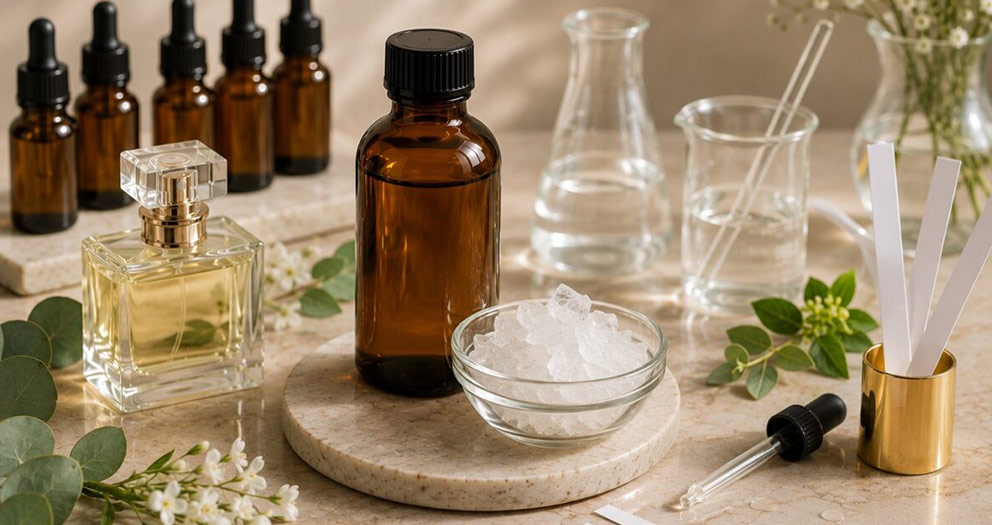
If there is one question every formulator asks before they start, and keeps asking for months afterward, it is this: how to dose aroma molecules and how much do I actually use from the raw material I have just received?
The honest answer is that dosage in perfumery is not a fixed rule. It depends on the molecule, the application, the other materials in your formula, and what you are trying to achieve. But every experienced formulator started somewhere, and that somewhere is a working range: a bracket of percentages that gives you a useful creative starting point without wasting material or overwhelming your blend.
This article gives you that bracket for every aroma molecule we stock, along with a few things worth understanding before you start measuring.
What these percentages refer to
All percentages in this guide are expressed by weight within the fragrance concentrate. The values in the table below are suggested creative starting ranges within the concentrate. They are not regulatory maximums, safety limits, or universal formulation rules. They reflect practical experience of where these materials typically begin to contribute meaningfully to a formula, and where they tend to become intrusive or dominant.
For regulatory compliance, the applicable IFRA category limits and current IFRA documentation always take precedence over the ranges suggested here. IFRA limits are calculated at the level of the finished consumer product, not the fragrance concentrate. If you are making an Eau de Parfum at 20% fragrance load, for example, a molecule at 5% in your concentrate represents 1% of the final product. Always cross-reference your concentrate percentages against the correct IFRA category for your intended application before use.
For our pre-diluted materials, including Ethyl Maltol 10% DPG, Coumarin 10% DPG, Vanillin 25% DPG, Galaxolide 50% DPG, and Ambroxan 10% IPM, the percentages in the table refer to the supplied dilution as-is, not to the neat active ingredient. You are dosing the bottle you received, not calculating back to the pure material.
DPG (Dipropylene Glycol) and IPM (Isopropyl Myristate) are functional carriers used to dissolve or dilute specific materials. Their suitability and use level depend on the material being diluted and the intended application. They are not interchangeable solvents and should not be treated as general-purpose diluents without considering the formulation context.
Recommended starting dosages
| Material | Suggested starting range in concentrate | Notes |
|---|---|---|
| Iso E Super | 2-15% | Smooth, diffusive, woody-ambery; a structural support material at low doses and a bold compositional statement at high doses |
| Acetyl Cedrene | 0.5-5% | Warm, cedarwood-adjacent; blends quietly at low doses |
| Ethyl Maltol 10 DPG | 0.2-3% of supplied dilution | Sweet, candy-like; use with restraint or it dominates |
| Hedione (MDJ) | 2-20% | One of the most generous ranges in perfumery; diffusive and transparent even at higher doses |
| Galaxolide 50 DPG | 2-10% of supplied dilution | Clean musk; supplied at 50%, so real-world active content is half the percentage used |
| Dihydromyrcenol | 0.5-5% | Fresh, citrus-clean; a backbone material for aquatic and fresh fougere structures |
| Coumarin 10 DPG | 0.5-5% of supplied dilution | Warm, hay-like sweetness; essential in ambery and fougere bases |
| Vanillin 25 DPG | 0.5-5% of supplied dilution | The standard vanilla reference; this dilution keeps it workable without crystallisation |
| Linalool | 0.5-5% | Floral-woody and highly versatile; present in hundreds of natural materials |
| Ethylene Brassylate | 1-10% | Musky and skin-close; blends smoothly across a wide range |
| Phenylethyl Alcohol | 1-10% | The rosy backbone molecule; forgiving and highly blendable |
| C16 Aldehyde | 0.1-1% | Creamy strawberry-peach fruitiness with a sweet, softly floral character; impactful even at low doses |
| Gamma Decalactone | 0.1-2% | Ripe peach character; surprisingly impactful at very low doses |
| Cashmeran | 0.2-3% | Warm, woody, slightly spicy musk; dose conservatively at first |
| Benzyl Salicylate | 1-10% | Soft floral-balsamic; often used as a fixative and blender |
| Helional | 0.2-2% | Marine, ozonic, with a metallic edge; directional and dose-sensitive |
| Ambroxan 10 IPM | 1-10% of supplied dilution | The modern amber benchmark; supplied at 10%, so the active concentration is much lower than the dose figure suggests |
| Sandalore | 0.5-5% | Smooth sandalwood effect; blends well with musks and soft woods |
| Methyl Ionone Gamma | 0.5-5% | Violet, iris, powdery; a classic in floral and ambery structures |
| Floralozone | 0.05-0.5% | Extremely potent; start at the very bottom of this range and work up slowly |
| Methyl Pamplemousse | 0.2-2% | Distinctive grapefruit character; impact-heavy for its dose |
| Ethyl Butyrate | 0.02-0.2% | One of the most potent materials in this list; fruity and tropical at micro-doses |
| Benzyl Benzoate | 0.5-5% | Mild balsamic character; widely used as a fixative and diluent for heavier materials |
The molecules that will surprise you
A few materials in this list behave very differently from what beginners expect and are worth calling out specifically.
C16 Aldehyde, Floralozone, and Ethyl Butyrate have some of the lowest suggested ceilings on this list for a reason. These are high-impact materials where a small miscalculation can become immediately noticeable. Start at the bottom of the suggested range and evaluate carefully before adding more. If your blend becomes excessively sharp, candied, artificial, or unbalanced, check these materials first.
Hedione sits at the opposite end of the spectrum. Its suggested range goes up to 20%, which sounds alarming but is well-supported in real formulas. It is one of the most transparent and diffusive molecules available, opening up other materials rather than competing with them. Don’t be afraid of it.
Iso E Super has a wide range because it serves genuinely different functions at different doses. At 2-3% it works as a smooth, diffusive support, adding woody-ambery depth without drawing attention. At 10-15% it becomes the compositional focus. Know what role you want it to play before you dose it.
Ambroxan 10 IPM can be disorienting at first because the supplied dilution means you are using a relatively large amount of the supplied dilution for a small amount of active material. Trust the range. At 1-10% of the dilution, you are working with 0.1-1% of the actual Ambroxan in your concentrate. That is a practical starting zone.
How to evaluate before you commit
Begin evaluation on a scent strip, not on skin. Strips let you assess the character and direction of a material or blend without introducing variables such as body temperature, substrate interaction, or dilution effects that complicate early assessment.
For materials with moderate impact, a 10% solution in DPG on a strip is a useful starting point for understanding what you are working with. For high-impact materials such as Floralozone and Ethyl Butyrate, begin at 1% or below. Evaluating these at 10% will tell you very little beyond the fact that they are powerful.
Skin evaluation should only be carried out using a properly diluted finished formula that has been checked against the applicable IFRA limits for the intended application. Never apply raw materials or fragrance concentrates directly to skin.
What smells linear or one-dimensional at high concentration on a strip may reveal more complexity when properly diluted, evaluated over time, or incorporated into a finished formula. Dilution, evaporation rate, temperature, and substrate all affect how a material is perceived. Strip evaluation is the starting point, not the final word.
Each molecule in this table links to its full product page, where you will find the complete olfactive profile, applicable IFRA restrictions and safe-use information, formulation guidance, and pairing suggestions. The dosage ranges above are your creative starting point. The product pages are where you go deeper.
Foarte utile moleculele. Veti adauga si altele?