

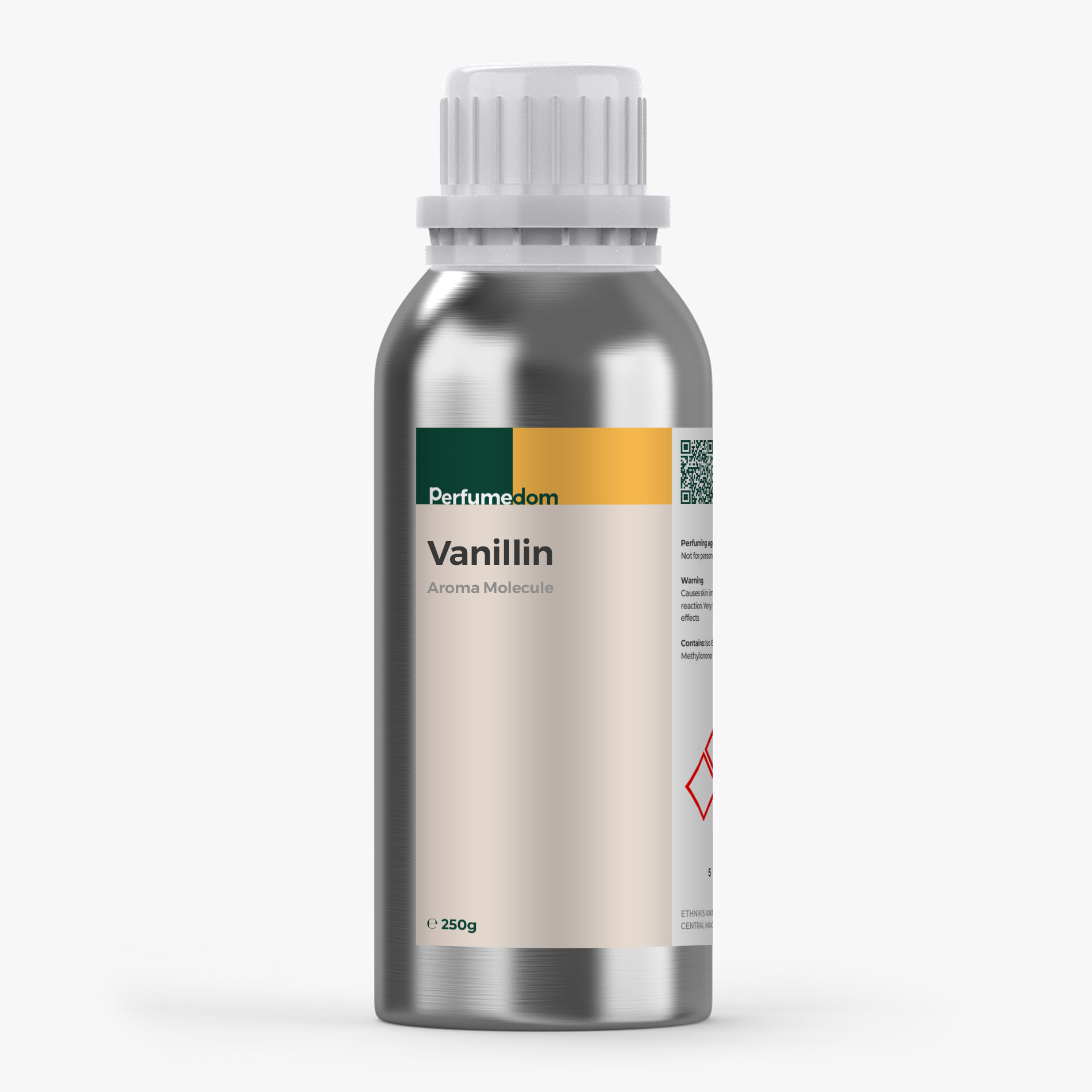
Vanillin 25 DPG Aroma Molecule
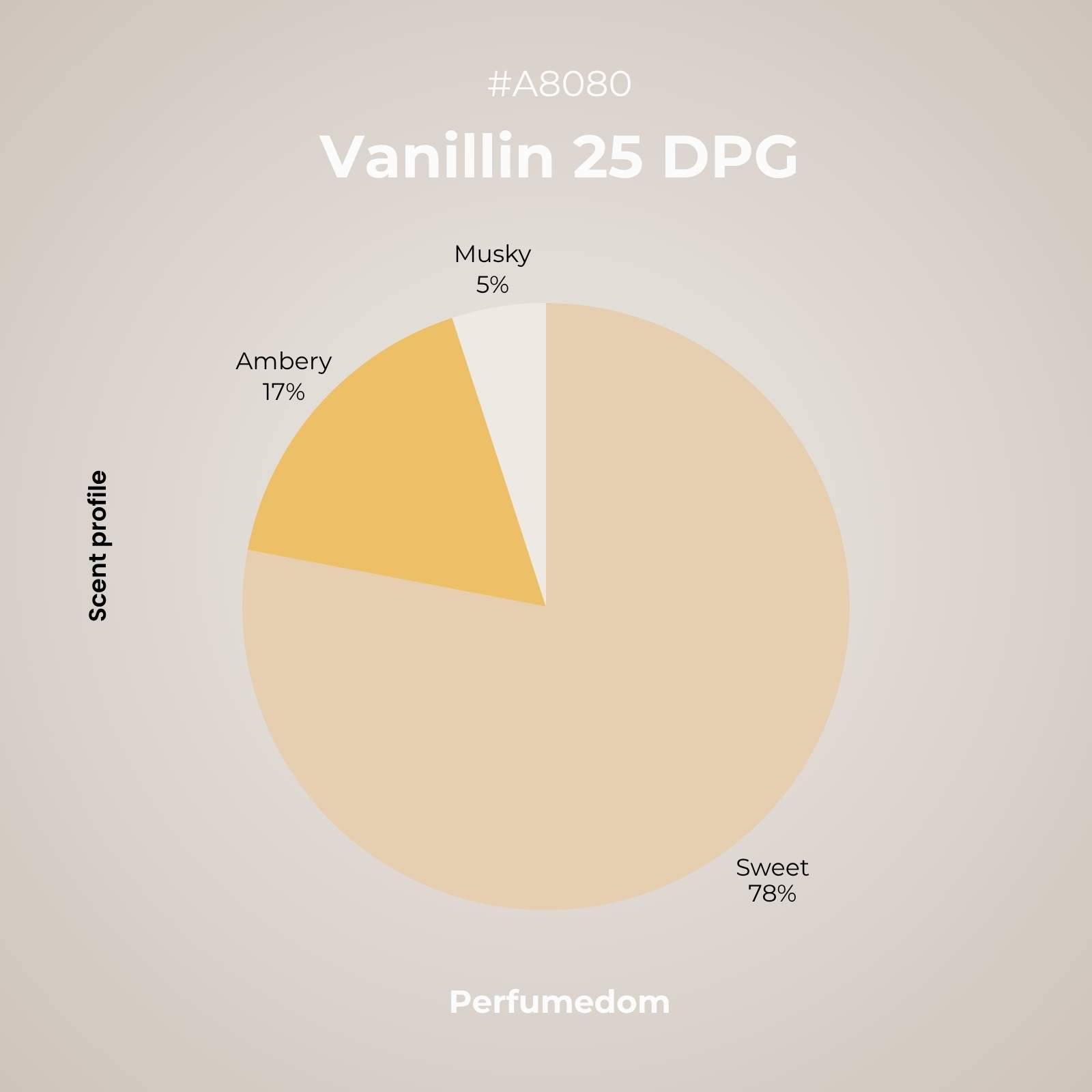
Vanillin is one of the most recognisable aroma molecules in the world, responsible for the familiar creamy sweetness associated with vanilla. Its character is soft, warm, comforting, and gourmand, with a profile that can suggest vanilla bean, custard, cream, soft cake, and sweet powder. In perfumery, it is rarely used only to create “vanilla”; it also rounds harsh edges, warms florals, softens musks, supports ambers, and gives gourmand accords their familiar edible charm. It is highly versatile, but it must be handled carefully because it can dominate a formula and strongly affect colour over time.
- Main impression: Creamy vanilla sweetness
- Supporting facets: Custard, cream, soft powder, warm sugar
- Drydown character: Sweet, creamy, comforting, long-lasting
- Used for: Vanilla accords, gourmand warmth, sweetness, amber depth, formula rounding
Please note
This material is supplied as a 25% active solution in DPG, not as neat Vanillin crystals. Adjust your formula dosage according to the active vanillin content. Usage levels should be calculated based on the supplied product and the final concentration of active Vanillin in your formula. It is not a finished fragrance and should not be applied directly to the skin.
Full safety, allergen, IFRA, and technical information is provided in the SDS, IFRA Certificate, and Allergen Declaration available in the “Related Documents” tab. Compliance and documentation of the final product remains the responsibility of the manufacturer.
Packaging note: 10g sizes are supplied in PET bottles for affordable small-quantity access. Production sizes from 50g upwards are supplied in premium aluminium bottles for improved long-term protection. Read more
Olfactive Profile
- Primary character: Sweet creamy vanilla with warm gourmand depth.
- Secondary nuances: Custard, cream, soft powder, cake, warm sugar, and gentle balsamic sweetness.
- Texture: Creamy, smooth, rounded, and comforting rather than fresh or sharp.
- Diffusion: Moderate, with strong recognisability even at low levels.
- Tenacity: Long-lasting, especially in gourmand, amber, vanilla, musk, and powdery compositions.
- Comparison anchor: Creamier and more vanilla-like than Coumarin, less caramelised than Ethyl Maltol, and softer than Ethyl Vanillin.
Vanillin smells familiar, warm, sweet, and creamy, with the comforting impression of vanilla custard, soft cake, and sweet powder. It is not simply a sugary material; it has a rounded creamy depth that can soften almost any composition. In small amounts, it adds warmth and smoothness. In larger amounts, it becomes a clear vanilla signature and can define the entire fragrance direction.
Formulation & Creative Uses
What It Adds to Your Formula
- Vanilla identity: Builds the recognisable creamy vanilla heart of gourmand accords.
- Sweetness: Adds soft edible sweetness without the candy effect of Ethyl Maltol.
- Creaminess: Smooths florals, musks, ambers, woods, and lactonic structures.
- Warmth: Gives formulas a comforting, rounded, long-lasting base.
- Amber support: Strengthens warm oriental, balsamic, resinous, and powdery compositions.
- Softness: Reduces harshness and makes sharp notes feel more approachable.
What It Does Not Do
- It does not create a full vanilla accord alone: It needs support from balsams, lactones, musks, woods, or spices for a complete vanilla profile.
- It does not add freshness: It is warm, sweet, and creamy rather than bright or aromatic.
- It does not behave like natural vanilla extract: It gives the core vanilla molecule, not the full complexity of vanilla absolute or oleoresin.
- It is not colour-neutral: Vanillin is well known for yellowing and browning in many bases over time.
Creative Uses
Vanillin is excellent for vanilla accords, gourmand fragrances, amber bases, powdery florals, tobacco blends, bakery profiles, creamy musks, lactonic compositions, and sweet oriental structures. It can soften jasmine, rose, ylang ylang, and orange blossom, add comfort to clean musks, and create warmth beneath woods and resins. In home fragrance, it is especially useful for cozy, bakery, amber, festive, dessert, and soft comfort profiles.
Creative Inspiration
Use Vanillin with Ethyl Maltol and Coumarin for a rich gourmand base with caramel, tonka, and creamy vanilla warmth. Pair it with Benzoin Essential Oil for balsamic vanilla depth. Combine it with Patchouli Essential Oil for darker amber-gourmand structure. Use it with Galaxolide 50 DPG or Ethylene Brassylate to create a soft creamy musk drydown.
Common Applications
- Fine fragrance: Useful in vanilla, gourmand, amber, tobacco, powdery floral, creamy musk, and oriental compositions.
- Candles & wax melts: Suitable where the final formula allows; especially useful for vanilla, bakery, caramel, amber, festive, and cozy candle profiles.
- Reed diffusers: Adds sweet creamy depth, subject to solubility and base compatibility.
- Room sprays: Useful for warm, sweet, gourmand, vanilla, amber, and cozy home fragrance profiles.
- Soaps & rinse-off products: Can support vanilla, powdery, sweet floral, and gourmand profiles within the relevant safety requirements.
- Cosmetic fragrance bases: Suitable for formulated cosmetic fragrances where permitted by IFRA and final product safety assessment.
Usage, Dose & Performance
- Suggested starting dose: 0.1–2% of the fragrance concentrate for early trials.
- Trace use: Adds warmth, smoothness, and soft sweetness.
- Moderate use: Creates a clear creamy vanilla effect.
- High use: Becomes dominant and can turn the formula strongly gourmand or confectionery.
- Diffusion: Moderate, but highly recognisable.
- Tenacity: Long-lasting, especially in sweet, amber, musk, and gourmand bases.
- Blending behavior: Works well with lactones, musks, ambers, balsams, woods, florals, spices, fruits, tobacco notes, and bakery accords.
- Overdose risk: Can make a formula too sweet, heavy, flat, or overly familiar if not balanced with freshness, dryness, bitterness, or texture.
Because this material is already supplied at 25% in DPG, dosage should be understood as the supplied solution, not pure Vanillin. For example, using 4% Vanillin 25 DPG in a concentrate contributes approximately 1% active Vanillin and 3% DPG.
Pairing Suggestions
Pairs well with aroma molecules
- Ethyl Maltol: Adds caramelised sugar and modern gourmand sweetness.
- Coumarin: Builds tonka warmth and powdery aromatic depth.
- Gamma Decalactone: Creates creamy peach, milk, and lactonic dessert effects.
- Ethylene Brassylate: Softens the vanilla with clean musky warmth.
- Iso E Super: Adds dry woody contrast and modern structure.
- Ambroxan: Gives ambergris warmth and longer-lasting sensual depth.
Pairs well with essential oils
- Benzoin Essential Oil: Builds rich balsamic vanilla depth.
- Patchouli Essential Oil: Adds dark earthy warmth and oriental structure.
- Ylang Ylang Essential Oil: Creates creamy floral-gourmand sensuality.
- Orange Essential Oil: Adds juicy brightness to sweet vanilla accords.
- Cardamom Essential Oil: Gives spicy lift and elegant warmth.
- Amyris Essential Oil: Adds soft woody creaminess beneath the vanilla.
Pairs well with base accords
- Vanilla Accord: Strengthens the creamy core of vanilla compositions.
- Chocovan Accord: Adds chocolate, cream, and dessert-style richness.
- Amber Accord: Builds warm oriental depth and balsamic sweetness.
- Tobacco Black Accord: Creates dark vanilla-tobacco warmth.
- Rice Accord: Adds soft milky comfort and delicate powdery sweetness.
- Sandal Accord: Smooths the vanilla with creamy woody warmth.
Technical Data & IFRA Limits
- Commercial name: Vanillin
- Synonyms: 4-Hydroxy-3-Methoxybenzaldehyde
- INCI name: Vanillin
- IUPAC name: Vanillin
- CAS number: 121-33-5
- EC number: 204-465-2
- FEMA number: 3107
- FLAVIS number: 05.018
- Chemical class: Aromatic aldehyde
- Material form: Liquid solution
- Diluent / solvent: Dipropylene Glycol (75%)
- Flash point: >100°C
- Solubility: Soluble in alcohol; soluble in water at limited levels
- Allergen declaration: Vanillin is listed under the expanded EU fragrance allergen requirements.
IFRA 51st Amendment Limits
- Fine fragrance: < 100%
- Body creams, oils and lotions: < 100%
- Soap and rinse-off products: < 100%
- Reed diffusers: < 100%
- Room sprays: < 100%
- Candles: < 100%
No IFRA restriction is listed for this material under the 51st Amendment information supplied. IFRA percentages are maximum permitted levels, not recommended usage levels. The final product manufacturer is responsible for checking the correct IFRA category, calculating the final concentration, and confirming suitability in the intended application.
Stability & Handling
Vanillin 25 DPG should be stored tightly sealed in its original container, away from heat, light, humidity, and prolonged air exposure. It is supplied as a ready-to-use liquid dilution, so no grinding, melting, or pre-dilution is normally required before formulation. Because Vanillin is naturally crystalline, slight crystal formation may occur after long storage or if the material has been kept in a cold environment. If this happens, place the closed bottle in a warm water bath for a few minutes and shake gently until the material returns to a uniform liquid. Do not use boiling water, direct heat, microwaves, or open flame.
The DPG carrier improves handling and makes Vanillin easier to weigh, dose, and blend compared with neat Vanillin crystals. Discoloration risk still applies because the active material is Vanillin, even though it is diluted. Testing is recommended in white waxes, pale soaps, clear bases, and pastel formulations.
It has a high discoloration potential in pale applications (discoloration risk still applies because the active material is Vanillin, even though it is diluted). It is well known for causing yellowing or browning over time, especially in white waxes, soaps, clear bases, and pale cosmetic formulations. The effect can become stronger with higher dosage, heat exposure, alkaline systems, oxidation, and long storage. Testing is strongly recommended before using Vanillin in white, pastel, transparent, or colour-sensitive products.
Safety & Testing
Vanillin is a raw fragrance material for formulation use. It is not a finished perfume and must not be applied directly to the skin undiluted.
Always review the SDS, IFRA Certificate, Cosmetics Declaration, and Technical Data Sheet before use. Test the material in the intended base before production, as performance may vary depending on dosage, solvent system, wax type, diffuser base, surfactant system, pH, processing temperature, and packaging.
Final product safety, labelling, IFRA compliance, CLP classification, allergen declaration, cosmetic assessment, and market compliance remain the responsibility of the final product manufacturer.
Explore Similar Scents



Why Choose Perfumedom
⚡ Swift Response Times
With a 97% stock uptime and our efficient order fulfillment system, your fragrance oils are delivered promptly, ensuring you meet your production timelines.
⭐ Consistent Performance
Our fragrance oils are sourced from established European manufacturers and designed for professional use, offering consistency and performance in every batch.
🛡️ Commitment to Safety
Every fragrance in our assortment is supported by up-to-date SDS, IFRA, and CLP guidance, and manufactured strictly only with REACH regulated substances.
Reviews
There are no reviews yet