
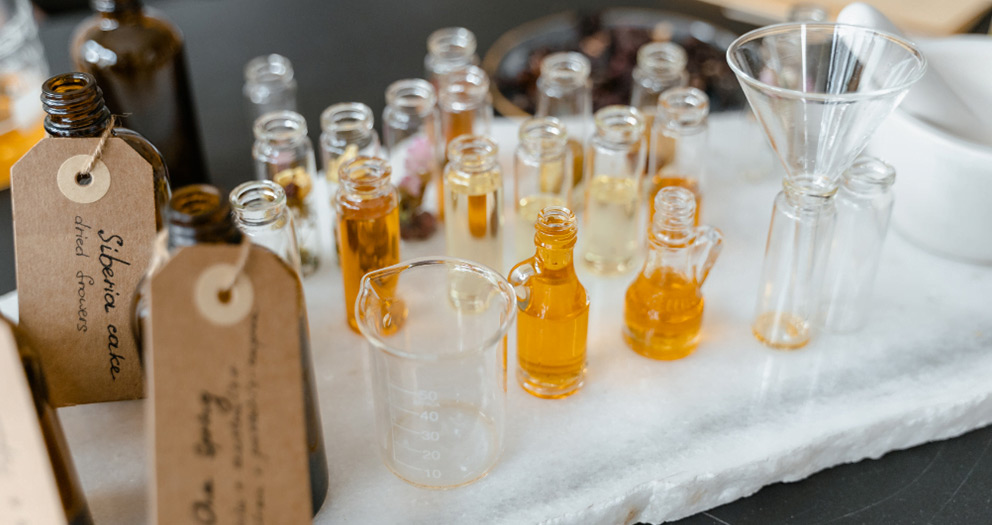
Perfume-making with fragrance oils looks like the simplest thing in the world: add alcohol, shake, spray. In practice it is a small formulation exercise with its own rules, which is why a blend can come out weak, fade within the hour, project poorly, or cling to the skin instead of radiating. When that happens, the oil is usually the first suspect. Is it too diluted? Is the solvent to blame? Almost always, neither.
A weak perfume result does not automatically mean that the fragrance oil is low quality, diluted, or defective. Perfume performance is not controlled by concentration alone. It depends on the structure of the fragrance, the solvent system, the volatility of the materials, the IFRA limit for skin use, the way the perfume is aged and filtered, and how it behaves on skin.
A 20% fragrance oil perfume can perform beautifully. It can also perform poorly. The percentage alone does not prove very much.
When the Fragrance Oil Is the Perfume
A fragrance oil is a raw material, something a maker usually builds into a candle, a diffuser, a soap, or a cosmetic. Many people skip that step and use the oil directly as a personal perfume, diluting it in alcohol and wearing it on skin. This is a legitimate use, provided it stays within the material’s own IFRA limit for leave-on skin products.
When that perfume underperforms, the two usual suspects are the solvent and the concentration. Both are fair questions. Both are usually the wrong suspect.
The solvent in your perfume is the one you added. A compounded fragrance oil may contain a small functional carrier, formulated in by the manufacturer for stability and handling. That fraction is minor, and it does not determine how your finished perfume performs. The dominant solvent in your bottle is the alcohol or diluent you added during blending.
If your perfume feels flat or fades quickly, the carrier inside the fragrance oil is almost never the cause. The base you built around it, and the composition itself, are far more important.
A Fragrance Oil Is Not the Same as a Finished Perfume
A fragrance oil is a ready-made aromatic blend used as a raw material for further formulation. Depending on the specific oil and its documentation, it may be used in candles, wax melts, reed diffusers, soaps, cosmetics, room sprays, or personal fragrance.
This does not mean that every fragrance oil on the market will behave like a finished commercial perfume when it is simply mixed with alcohol.
A finished perfume is not only a smell direction. It is a complete formula built around skin evaporation, diffusion, drydown, cost structure, regulatory limits, and performance targets. It may also use specific musks, amber materials, captive molecules, bases, or diffusion materials chosen specifically for fine-fragrance behaviour by the specific fragrance house.
A fragrance oil can still be well made and useful, but it should be understood for what it is: a formulation ingredient. Some fragrance oils are simple and affordable. Others are more complex and expensive. Some perform beautifully on skin, while others are better suited to candle, diffusers, or room products. The result depends on the formula, not on the words “fragrance oil” alone.
It is also important to compare like with like. A handmade perfume made by just adding alcohol to a ready-made fragrance oil blend should not automatically be expected to perform like a luxury finished perfume built with a much larger formula budget, ultra rare extracts, proprietary materials, and a complete fine-fragrance structure.
This is not a quality defect. It is a formulation reality.
Why a 20% Fragrance Oil Perfume Doesn’t Always Last
Using 20% fragrance oil in alcohol does not guarantee a strong perfume.
This often surprises people. Roughly speaking, eau de toilette sits around 5 to 15% fragrance, eau de parfum around 15 to 20%, and extrait around 20 to 40%. These are approximate industry ranges rather than fixed rules, but they place 20% squarely in eau de parfum to extrait territory.
The problem is almost never too little oil.
A fragrance oil is already a complete formula. When you use it at 20%, you are using 20% of that full blend, including all of its internal balance of light and heavy materials. If the blend is built around light, fast-evaporating molecules, it will behave that way no matter how much you use.
Citrus, fresh, aquatic, tea, light floral and soft fruity profiles are built largely from volatile materials. They evaporate quickly. They will be fleeting at 5% and still fleeting at 40%.
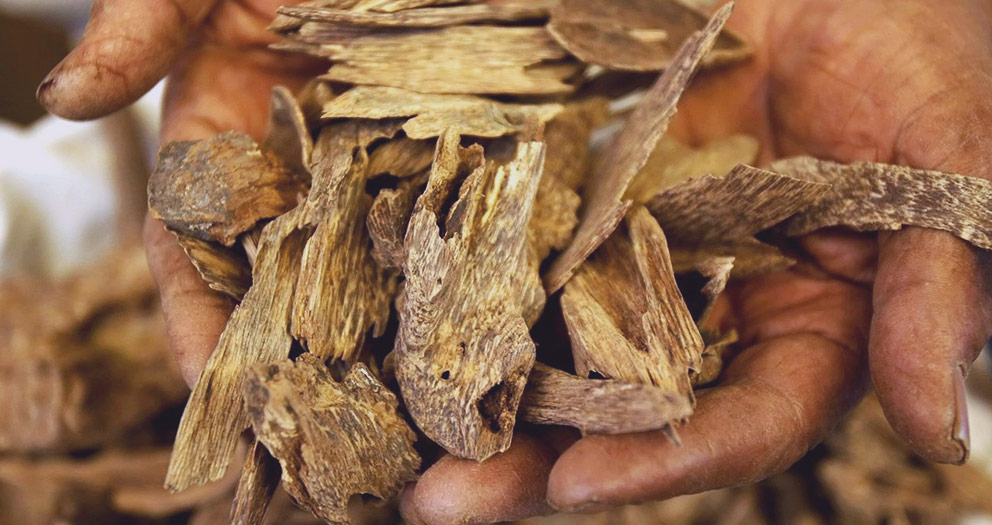
Heavy, long-lasting performance comes from base materials: woods, musks, resins, ambers, balsamic notes. These release slowly and anchor the fragrance on skin.
More oil does not change the volatility of the molecules inside it. In some cases, increasing the percentage can even reduce diffusion or push the formula beyond its safe-use limit.
Persistence, Diffusion and Projection Are Different Things
Performance is not one single property. Persistence is how long the scent lasts, diffusion is how well it spreads into the air, and projection is how far it pushes away from the skin.
A fragrance can last for hours but stay close to the skin. Another can project strongly at first and fade quickly. These behaviours are built into the formula. They are not fixed by increasing concentration.
Solvent Is Not the Issue
Carriers and solvents are part of fragrance formulation. They are used to dissolve and stabilise materials inside the blend. They do not determine whether a fragrance projects or lasts.
The key factor is always the composition of the fragrance itself, along with the base you dilute it into. A proper high-proof perfumer’s alcohol behaves very differently from a low-proof or watery alcohol solution, but even then, the structure of the fragrance remains the dominant factor.
IFRA Limits Matter
Before using any fragrance oil in a personal perfume, check the IFRA certificate for the correct application category.
Personal perfumes fall under fine-fragrance use. If the IFRA limit is low, you cannot increase the dosage beyond that limit. The maximum usage level is set by safety requirements, not by performance goals.
Inspired-By Oils Have Limits
Inspired-by fragrance oils are not the original perfumes they reference. They are creative interpretations inspired by a reference. They do not use the same exact materials, and they are not built with the same technical structure as commercial fragrances.
Even if the scent direction is similar, the performance profile can be different after dilution. Using an inspired-by oil at 20% does not guarantee the same projection or longevity as the original fragrance.
The Perfume Base Also Matters
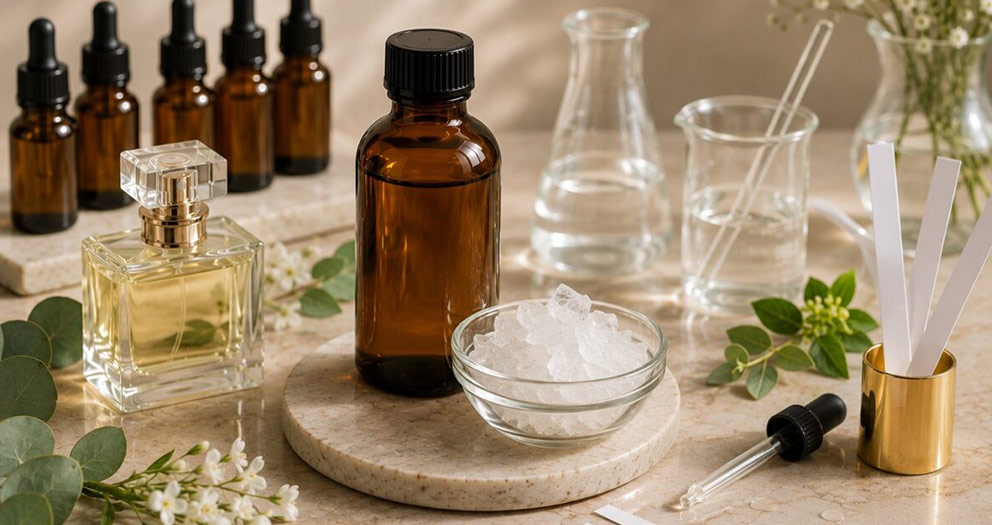
A personal perfume is not just fragrance oil plus any alcohol. Alcohol quality, water content, solubility, filtration, use of fixatives and maturation all affect the final result.
A blend should be allowed to settle before evaluation. Freshly mixed perfume often smells flat and wears short until it has rested, sometimes for several weeks in a cool, dark place. This improves smoothness and integration, but it does not change the fundamental volatility of the fragrance.
Application also matters. Under-application, very dry skin, and normal nose fatigue can all make a perfume seem weaker than it actually is.
How to Improve Performance
- Start with the right type of fragrance. If you want longevity and projection, choose blends built around heavier base materials: amber, musk, vanilla, woods, resins, tobacco, spices.
- Check the IFRA certificate before deciding on concentration.
- Test different levels within the allowed range. Higher is not always better.
- Use a proper perfume alcohol base (Denaturated >95°).
- Allow the blend to mature before judging it.
- Test on both blotter and skin.
- If needed, treat the fragrance oil as part of a larger formula. Perfumers often build around a core accord by adding materials that increase lift, diffusion, or persistence. Musks, ambers, woods and top-note boosters can all change how a fragrance performs.
What Not to Do
- Do not assume that increasing the percentage will fix performance.
- Do not assume that weak projection means the oil is diluted.
- Do not expect every fragrance oil to behave like a finished commercial perfume.
- Do not ignore IFRA limits.
- Do not judge performance based only on how strong the oil smells in the bottle.
The Realistic Answer
Fragrance performance comes from the materials inside the blend. Light, volatile compositions will always be short-lived. Heavy, base-rich compositions will last longer and project more.
There is also a natural trade-off. The molecules that project the most are often the ones that evaporate fastest, while the ones that last longest tend to stay closer to the skin. Strong projection and very long wear are not simply achieved by adding more oil, they are the result of specific formulation choices.
Concentration does not override chemistry.

Vă mulțumesc pentru articol. Explicații foarte usor de înțeles. Este util să aflu ca o formula construita cu unul sau mai multe din uleiurile dumneavoastră, poate necesita, după caz, unele molecule care sa ajute performantele (Hedione, Iso E Super, Ambroxan).