
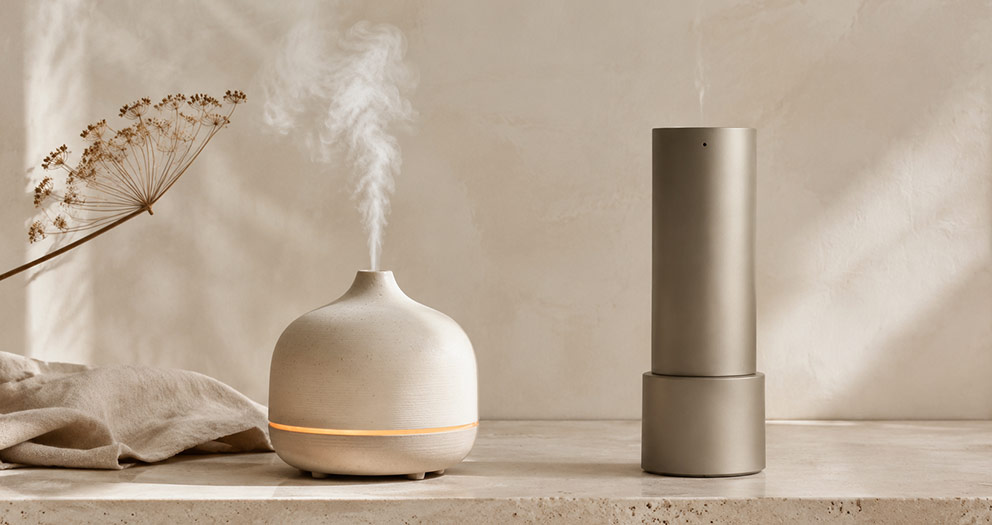
“Diffuser” gets used for a dozen genuinely different pieces of hardware, an ultrasonic mister, a waterless nebulizer, a plug-in wick refill, a catalytic lamp, a fan over a pad, and each one has its own rules for what liquid it’s built to run. That’s why “can I use fragrance oil in my diffuser” doesn’t have one answer, it has one answer per mechanism. This guide walks through each type so you can find yours and know where you stand, rather than trial-and-error on a device you paid for.
Can you use fragrance oils in a diffuser? Sometimes, but not in every type of diffuser, and never based on the word “diffuser” alone. Perfumedom fragrance oils are concentrated B2B formulation materials, not universal ready-to-use diffuser refills. Compatibility depends on the device’s mechanism, its permitted liquid type, viscosity requirements, and internal materials, all of which are set by the equipment manufacturer, not by us.
The one paragraph that matters most
We do not approve individual diffuser brands or models, and we don’t accept customer devices for testing. Check your device’s own manual or fluid specification first. If the manual doesn’t clearly identify the permitted liquid type, treat compatibility as unconfirmed, testing your own device can tell you whether something works, but it doesn’t establish manufacturer approval or protect your warranty either way.
These principles aren’t unique to Perfumedom, they come from how fragrance formulation, delivery mechanism, and equipment materials interact with each other, not from whose bottle the oil came from.
Quick reference, by mechanism
| Device mechanism | Verdict |
|---|---|
| Ultrasonic water-mist diffuser | Not recommended as a default. Some devices expressly permit a few drops, follow that device’s manual, not a general rule. |
| Humidifier (not sold as a diffuser) | No, unless it has a dedicated aroma tray built in. Don’t add oil to the water tank. |
| Heated water aroma bowl | Manufacturer-dependent. A few drops are sometimes permitted even though the oil won’t dissolve. |
| Cold-air / nebulizing diffuser (waterless, compressor or venturi) | Conditional. Neat oil can clog fine nozzles. We offer a made-to-order premix for this, see below. |
| Piezoelectric / waterless microdroplet diffuser | Treat separately from compressor-style cold-air units, check the manufacturer’s fluid spec, don’t assume cold-air guidance carries over. |
| Open-dish electric warmer (flameless, no water) | Yes, diluted in a suitable carrier, only if the device permits open liquid fragrance. |
| Tealight aroma burner | Follow the manufacturer’s instructions exactly, many are designed for water plus a few drops of fragrance oil, not a no-water liquid mixture. Never let the bowl run dry. |
| Wax melts / wax warmers | Yes, but the fragrance is blended into the wax itself as the carrier, not into DPG or any liquid carrier. |
| Reed diffuser | Yes, diluted in a purpose-designed reed-diffuser base. |
| Evaporative / fan diffuser (pad or wick, airflow only) | Generally the most tolerant option, but check the pad, wick, and any plastics or adhesives for solvent compatibility. |
| Heated-wick plug-in refill (Air Wick-style) | No. Proprietary systems, designed for their own cartridge only. |
| Catalytic / effusion lamp (Maison Berger-style) | No. These need dedicated catalytic lamp fluid, a fragrance oil or diffuser premix is not that. |
| HVAC / commercial scent-marketing system | Only where the equipment manufacturer explicitly permits third-party fragrance liquid and gives you a fluid spec. Not a default yes. |
| Aroma jewellery, diffuser stones, other passive porous items | No blanket answer, material-dependent, needs its own testing. |
| Car diffuser | Not a mechanism on its own, it’s a location. Whatever device it is (usually cold-air, ultrasonic, or a passive vent clip), follow that mechanism’s guidance above. |
| Medical nebuliser, CPAP, steam inhaler | No. Fragrance oils are not medical inhalation products, full stop. |
Can You Use Fragrance Oil in an Ultrasonic Diffuser? (and other water-based devices)
Our standard fragrance oils are not supplied or certified as water-soluble or water-dispersible. Added to water, they don’t behave like a formulated water-based product, they remain a separate phase or form uneven droplets, similar to any oil dropped into water. What that means in practice varies by device:
- On many ultrasonic diffusers, undissolved oil sits on the surface, gives inconsistent output (strong at first, then weak), and over repeated use can coat the ultrasonic plate with residue that’s hard to clean off. Using a liquid the manufacturer hasn’t authorized can damage the device or invalidate its warranty.
- Some ultrasonic diffusers are explicitly designed and marketed to accept a few drops of oil in water. If your device’s own manual says that, follow the manual, that’s the manufacturer’s call, and it overrides anything general we say here.
- Heated water aroma bowls (a warmed dish of water, no ultrasonic element) sometimes tolerate a few drops in the same way, again, check the specific device.
- Plain humidifiers not sold as fragrance devices generally shouldn’t have oil added to the tank at all, unless there’s a separate aroma tray built in for that purpose.
If you’re building a water-based scenting product rather than using an off-the-shelf diffuser, the real answer is a fragrance formulated with an emulsifying or solubilizing system so it actually disperses in water. That’s a different product from our standard range, not a dilution trick, talk to us about private-label or custom development if that’s your use case. Note that solubilizing the fragrance is one piece of a bigger job, a commercial water-based product will typically also need stability testing, packaging compatibility checks, and an appropriate preservation system, that’s formulation development, not a single ingredient swap.
Can You Use Fragrance Oil in a Cold-Air or Waterless Diffuser?
These atomize fragrance directly with no water, so there’s no solubility problem, the friction point is mechanical: many fragrance oils run heavier than a fine nebulizer nozzle wants, which raises clogging risk, and using an oil neat also means labelling the finished product (CLP) at full strength, which for some compositions carries stronger hazard classifications than a diluted version would.
For B2B customers we offer a made-to-order 50% fragrance oil / 50% IPM (Isopropyl Myristate) premix, intended for evaluation in compatible cold-air scenting systems, at 1kg MOQ per fragrance. It is a practical starting point based on our own evaluations across several diffuser systems, it is not a guarantee of compatibility with your specific machine. Needle size, pump strength, tubing, and internal materials vary enough between manufacturers that we can’t make that call for you. See our 50/50 cold-air diffuser premix service for current specifications, pricing, and ordering.
If you want to test before committing to the 1kg premix minimum, note that a neat 10g tester is compositionally different from the 50/50 premix, so it only tells you about scent, not about clogging or atomization behaviour. A controlled 50:50 w/w trial, prepared by someone equipped to formulate safely, gets you a closer read on device performance, but it’s a customer-prepared test mixture, not covered by the SDS or CLP data we issue for the commercially supplied premix.
Piezoelectric or other waterless microdroplet devices are mechanically different from compressor-style cold-air units, don’t assume the same guidance carries over automatically, check that device’s own fluid spec.
Can You Use Fragrance Oils in an Electric Warmer?
Compatible when the device permits open liquid fragrance, diluted in a suitable carrier. DPG (dipropylene glycol) is a widely used, low-odour carrier for this in the industry, doesn’t interfere with the scent, but “widely used” isn’t the same as “universally correct for every device and every operating temperature,” so this is a starting point to test, not a guarantee.
The concentration is product-specific, not universal. Every one of our fragrance oils ships with its own IFRA certificate stating a maximum allowable concentration for the relevant end-use category, that’s a ceiling, not a recommended dose, and it doesn’t by itself determine the right formulation, scent performance, or device compatibility. Work from that certificate for the specific oil, ask us if you need it pulled.
Tealight burners specifically: many conventional tealight aroma burners are designed to run with water in the bowl plus a few drops of fragrance oil, not a no-water DPG mixture, follow that specific device’s instructions rather than assuming the open-dish electric guidance above carries over. And on either device, never let the bowl run dry over a flame.
Can You Use Fragrance Oil in a Wax Warmer?
Compatible, but note this is a different product from the open-dish liquid warmers above: the fragrance is blended directly into melted wax at the wax/candle IFRA limit, and the wax itself is the carrier. Don’t pour concentrated fragrance oil straight into a wax warmer dish expecting it to behave like a wax melt, and don’t carry a liquid-warmer dilution percentage over to wax work, they’re different IFRA categories with different limits.
Reed diffusers
Compatible, diluted in a purpose-designed reed-diffuser base at the IFRA-permitted concentration for that end-use category. Confirm your reed material is rated for whatever solvent system you use.
Evaporative / fan diffusers
Generally the most tolerant device on this list, airflow over an oil-soaked pad or wick, no water, no fine nozzle to clog. Scent throw is weaker than active devices, that’s the format’s tradeoff. Worth checking that the pad, wick, and any plastics or adhesives in the device are rated for whatever solvent or carrier you’re using, some materials can degrade or discolor with certain solvents over time.
Proprietary refill systems and catalytic lamps
Plug-in heated-wick air fresheners (Air Wick and similar) are built around their own cartridge, there’s no general way to refill these with a third-party fragrance oil. Catalytic or effusion lamps (Maison Berger and similar) are a different case again, they burn a dedicated catalytic lamp fluid through a ceramic stone, not a warming oil, a standard fragrance oil or our cold-air premix is not that fluid and isn’t a substitute for it.
Can You Use Fragrance Oil in an HVAC Scenting System?
Not a default yes. These are closed, engineered systems, cartridge pumps, ducted cold-air compressors, and their fluid specifications can be very particular. Only relevant where the equipment manufacturer explicitly permits third-party fragrance liquid and gives you a spec to work against, get that spec first, then we can talk about whether a specific oil in our range fits it.
Aroma jewellery, diffuser stones, and other passive porous items
No blanket answer. Absorption, evaporation rate, staining, and leakage depend entirely on the specific porous material, ceramic, clay, lava stone, wood, terracotta all behave differently. This needs its own testing on the specific item, we supply the oil as a B2B material and can’t certify it for something this material-dependent.
Never: medical nebulisers, CPAP machines, steam inhalers
No. These are medical or medical-adjacent devices designed for pharmaceutical or therapeutic use, fragrance oils are not formulated, tested, or intended for inhalation through them. This isn’t a device-compatibility question, it’s a safety one.
Quick answers to follow-up questions
No. We do not manufacture or approve third-party equipment. A model name, photograph or product link is not enough to establish compatibility. Obtain the permitted-liquid specification from the equipment manufacturer and test the actual finished formulation.
Not by default. They are concentrated B2B formulation materials, not universal finished diffuser refills. Direct use is relevant only where the equipment manufacturer expressly permits that type of neat fragrance mixture.
Fragrance oil is normally a concentrated fragrance material. “Diffuser oil” generally means a finished formulation containing fragrance and a carrier or solvent selected for a particular delivery system. The terms are not interchangeable.
No, not automatically. A fragrance oil isn’t the same product type as a pure essential oil, it can differ in solvent system, viscosity, and material compatibility (and confusingly, a fragrance oil can itself contain essential oils as ingredients, that overlap doesn’t change the answer). If the manual specifies essential oils only, that doesn’t authorize fragrance oils.
“Aroma oil,” “perfume oil” and “diffuser oil” are not precise technical specifications. Ask the equipment manufacturer whether it accepts third-party fragrance or essential oil mixtures, whether they must be neat or diluted and which carriers are permitted.
Before using any third-party fragrance liquid, ask the equipment manufacturer to confirm:
- Whether third-party fragrance formulations are permitted
- Whether the device requires neat or diluted fragrance
- Which carriers are accepted or prohibited
- Whether the internal tubing, seals and reservoir are compatible
- Required cleaning and maintenance procedures
- Whether third-party liquids affect the warranty
If the manufacturer requires specific viscosity, density, surface-tension or other numerical properties, those must be measured on the actual finished formulation by the customer or a qualified laboratory. Perfumedom does not match catalogue oils to third-party equipment specifications or certify compatibility from numerical ranges alone.
Every fragrance has a different composition. Viscosity, volatility, colour, low-temperature behaviour and the presence of heavier materials can all affect atomisation. Successful testing of one fragrance does not confirm compatibility with another.
We can’t give a universal drop count, that’s set by the device and the water or reservoir volume, follow the device instructions.
Not by default. Reed-diffuser formulations are designed for capillary movement and passive evaporation, not mechanical atomisation. Their carrier system may perform poorly or clog a cold-air machine. Also, do not substitute or adjust carriers arbitrarily. IPM, DPG, Augeo and other bases are not interchangeable. Changing the carrier or ratio affects flow, evaporation, material compatibility, classification and performance. The revised formulation must be tested independently.
Don’t substitute alcohol based on this article. It changes flammability, evaporation behaviour, classification, and material compatibility, some specialised catalytic systems do run on alcohol-based fluid, but only as a purpose-built formulation the device manufacturer has approved, not a swap-in for our oils.
It may, only testing the actual finished mixture in the actual machine tells you for sure.
We don’t certify ambient fragrance products as pet-safe, infant-safe, or suitable for people with respiratory sensitivities, follow the device’s and finished product’s own safety instructions, keep ventilation adequate, and check with a vet or doctor where it’s relevant.
Strength in the bottle doesn’t guarantee strong atomization or room performance in your specific device, that’s a testing question, not a catalogue question.
No. Flash point is not a recommended operating temperature and doesn’t by itself establish device compatibility, the full formulation, the device’s actual operating temperature, and the manufacturer’s instructions all need to be assessed together.
Final answer
Can you use fragrance oils in a diffuser? Only when the device is built for that type of liquid and your finished formulation meets its requirements, the word “diffuser” alone doesn’t tell you that. Check what the manufacturer’s manual actually permits, test the real finished mixture in the real device, and if the documentation doesn’t say, treat it as unconfirmed rather than assumed.


Write a comment
Your email address will not be published. All fields are required