
Table of Contents
Regulation (EU) 2025/40 on Packaging and Packaging Waste, known as the PPWR, generally became applicable on 12 August 2026. These new EU Packaging Rules affect businesses of every size, including small candle makers, soap makers, home-fragrance brands and independent manufacturers selling products around Europe.
For a small maker, the obvious question is:
“I make a few products a day and ship them from my small workshop. Am I now expected to navigate a complex EU system just to sell them?”
The answer is: not in the way many simplified summaries suggest.
There are genuine obligations to understand, particularly around packaging documentation and cross-border EPR. But many of the PPWR requirements attracting the most attention do not become mandatory in August 2026. Several major recyclability, recycled-content, minimisation and reuse provisions phase in later, principally from 2028 to 2030 and beyond.
The key is to separate what applies now, what comes later, and what the EU is still discussing.
First: the PPWR is only about your packaging
The PPWR regulates packaging and packaging waste throughout its life cycle: how packaging is manufactured, what it is made from, how it is identified, how much packaging is used, whether it can be recycled or reused and who contributes towards managing it once it becomes waste.
For a small maker, this means looking at the packaging system surrounding the product: retail cartons, bottles and jars where they qualify as packaging, closures, labels, protective packaging, shipping cartons and fillers.
But one particularly useful exception exists for candle makers.
Candle containers have a specific exemption
The European Commission has specifically clarified that tea-light containers, graveside-light containers and other candle containers such as filled glasses and ceramic bowls are not packaging under the PPWR. They are treated as part of the candle product during its use rather than as packaging surrounding it.
So, for a candle maker, the compliance focus is generally the retail box, protective materials and shipping packaging, rather than the filled candle glass itself.
That exception should not automatically be extended to every product container.
The PPWR itself recognises bottles, jars, flacons and cosmetic pots as packaging formats. Therefore, a cosmetics maker should not assume that a cream jar or cosmetic bottle is outside PPWR simply because it remains with the product while being used.
Similarly, we would not advise reed-diffuser makers to assume that the Commission’s specific candle-container clarification automatically applies to diffuser bottles unless further official guidance confirms that interpretation for that format.
That is an important distinction: when the law gives us a clear exemption, we can use it. Where it does not, the safer approach is to treat an ordinary product bottle or jar as packaging.
What actually applies now?
The general PPWR framework has applied since 12 August 2026, but the obligations of manufacturers and importers must be read together with the individual application dates of Articles 5–12. The Commission expressly warns that many substantive requirements have later dates.
One area already relevant is packaging identification and traceability.
Packaging for which you are the PPWR manufacturer needs to be identifiable by a type, batch, serial number or another equivalent element. That does not mean inventing an individual serial number for every shipping box. The Commission says identification may operate at packaging type or production-batch level and simply needs to link the packaging to the relevant conformity documentation.
Relevant manufacturers and importers must also maintain technical documentation. The Commission confirms retention periods of five years for single-use packaging and ten years for reusable packaging.
Importantly, businesses do not need to throw away packaging they already had.
Packaging placed on the market before 12 August 2026 can remain there. Packaging already manufactured before that date but still held in stock does not automatically have to be destroyed, remade or relabelled; the Commission allows certain identification information to be supplied through accompanying documentation.
The Commission has also instructed authorities that enforcement immediately after 12 August should not unnecessarily disrupt trade. Where a compliance problem is found, operators should normally first be given an opportunity to correct it before stronger measures such as withdrawal or prohibition are considered.
That is not an exemption from the law. It is an indication that implementation is intended to be corrective and proportionate rather than an overnight exercise in removing products from shelves.
What about all the recyclability and “too much packaging” rules?
This is where much of the panic comes from. The EU Packaging Rules are phased in.
The PPWR absolutely moves Europe towards less packaging, greater recyclability, increased recycled content and more reuse. But it does not mean that every small maker had to redesign every box by 12 August 2026.
Packaging minimisation
The major packaging-minimisation requirements under Article 10 generally apply from 1 January 2030.
So the direction is clear: unnecessary packaging should disappear, and businesses should already begin designing more efficiently.
For example, a candle packed in a correctly sized protective carton with only the filler necessary to prevent breakage is much closer to the direction of travel than a small candle sitting inside several unnecessary layers and a dramatically oversized shipping box.
But 2030 requirements should not be presented as though they suddenly became mandatory in August 2026.
Recyclability
The PPWR’s binding recyclability performance system is also principally a 2030 requirement, subject to the adoption and timing of the Commission’s design-for-recycling delegated rules. The Regulation ultimately aims for packaging placed on the EU market to meet defined recyclability performance grades.
Recycled plastic content
Minimum recycled-content requirements for relevant plastic packaging are likewise primarily scheduled from 2030, with calculation and verification methodologies being developed beforehand.
This is particularly important for anyone using PET.
The new EU Packaging Rules do not simply say “PET is banned”. Their approach to plastic packaging is based on factors including recyclability and, for relevant formats, future recycled-content requirements.
Empty space
The well-publicised maximum empty-space requirement for grouped, transport and e-commerce packaging is also a later obligation. Article 24 provides for a maximum 50% empty-space ratio, with application from 2030 or later depending on the timing of the implementing methodology.
Again: prepare for it, but do not pretend it was an overnight August 2026 rule.
Small businesses: what applies specifically?
There is no blanket exemption from EPR simply because you are a micro-enterprise.
The Commission’s August 2026 FAQ is explicit: producers remain responsible for packaging that they make available for the first time on the territory of a Member State.
However, the PPWR deliberately reduces the administrative burden for small producers.
If you place less than 10 tonnes of packaging per year on the market of a particular Member State, fewer reporting requirements apply. Member States and producer responsibility organisations are also required to avoid imposing disproportionate burdens on small producers.
There is another extremely important micro-enterprise provision.
Where a micro-enterprise would otherwise be the manufacturer/producer of packaging but obtains that packaging from a supplier established in the same Member State, the supplier can assume the relevant PPWR role under the conditions set out in the Regulation. The Commission’s August FAQ confirms that, in the specific EPR situation it describes, the micro-enterprise can be exempted where the packaging supplier is established in that same Member State.
This is why sourcing packaging from established packaging suppliers matters.
Suppliers are required to provide manufacturers with the information and documentation necessary to demonstrate packaging conformity. The business legally responsible for the packaging must still ensure that the required documentation exists, but it is not expected to chemically analyse every cardboard box or independently reconstruct information its packaging supplier should already hold.
For many independent makers, good supplier documentation will therefore become one of the most important practical parts of PPWR preparation.
EPR: what is it, and is it a new EU import fee?
No, there is no new PPWR “EU import fee” on an ordinary sale from one EU Member State to another.
What customers are hearing about is Extended Producer Responsibility, or EPR.
EPR is a packaging waste-management system. The producer responsible for packaging in a Member State contributes towards the cost of collecting and recovering that packaging once it becomes waste.
The Commission explains that the producer must register, report and pay the relevant EPR contribution in the Member State in which the packaging is expected to become waste.
EPR itself is also not something that magically appeared for the first time on 12 August 2026. Member States already had packaging EPR systems under previous waste legislation. PPWR progressively harmonises important elements such as who qualifies as the producer, registration and reporting.
The Commission’s August FAQ states that the first reporting under the new harmonised PPWR register rules is expected by 1 June 2030. Existing national systems continue in the meantime.
Cross-border selling: the area that genuinely needs attention
This is the part of the new EU Packaging Rules that small online businesses should take seriously.
Suppose you operate a small candle webshop in Greece and a consumer in Germany orders directly from you.
Under the PPWR producer definition, an economic operator making packaged products available directly to an end user in another Member State can become the producer for EPR purposes in that destination country.
The Commission’s official guidance gives essentially this exact webshop example: if a company operates a webshop and sells packaged products directly to an end user in another Member State, the distance seller becomes the producer and must fulfil EPR obligations in the destination Member State.
This can therefore mean destination-country registration, reporting and EPR contributions.
It is a genuine administrative issue for small businesses selling throughout Europe.
And what about the authorised representative everyone is talking about?
This requires especially careful wording because the law today and the law being proposed are not the same thing.
Under the PPWR as currently applicable, an EU producer subject to EPR requirements in another Member State must appoint an authorised representative for EPR in that Member State.
That requirement is currently still in force.
The European Commission itself has acknowledged how burdensome this could become for intra-EU cross-border businesses. In December 2025 it proposed suspending the mandatory intra-EU authorised-representative requirement until 1 January 2035.
But that proposal has not become law.
As of 19 August 2026, the proposal remains a legislative file before the EU institutions. Parliament’s rapporteur has proposed narrowing the relief primarily to micro and small enterprises engaged in intra-EU cross-border activity.
There is also significant resistance in the Council. Parliament’s Legislative Train records that, because of strong reservations from a large majority of Member States, negotiations in the Council on the EPR authorised-representative proposals were discontinued.
Therefore, nobody should currently publish:
“Small businesses no longer need authorised representatives.”
That would be incorrect.
The accurate position is:
The requirement currently exists. The Commission has proposed relief. Parliament is considering changes focused particularly on smaller EU businesses, but the proposed relief has not yet been adopted and its final outcome is uncertain.
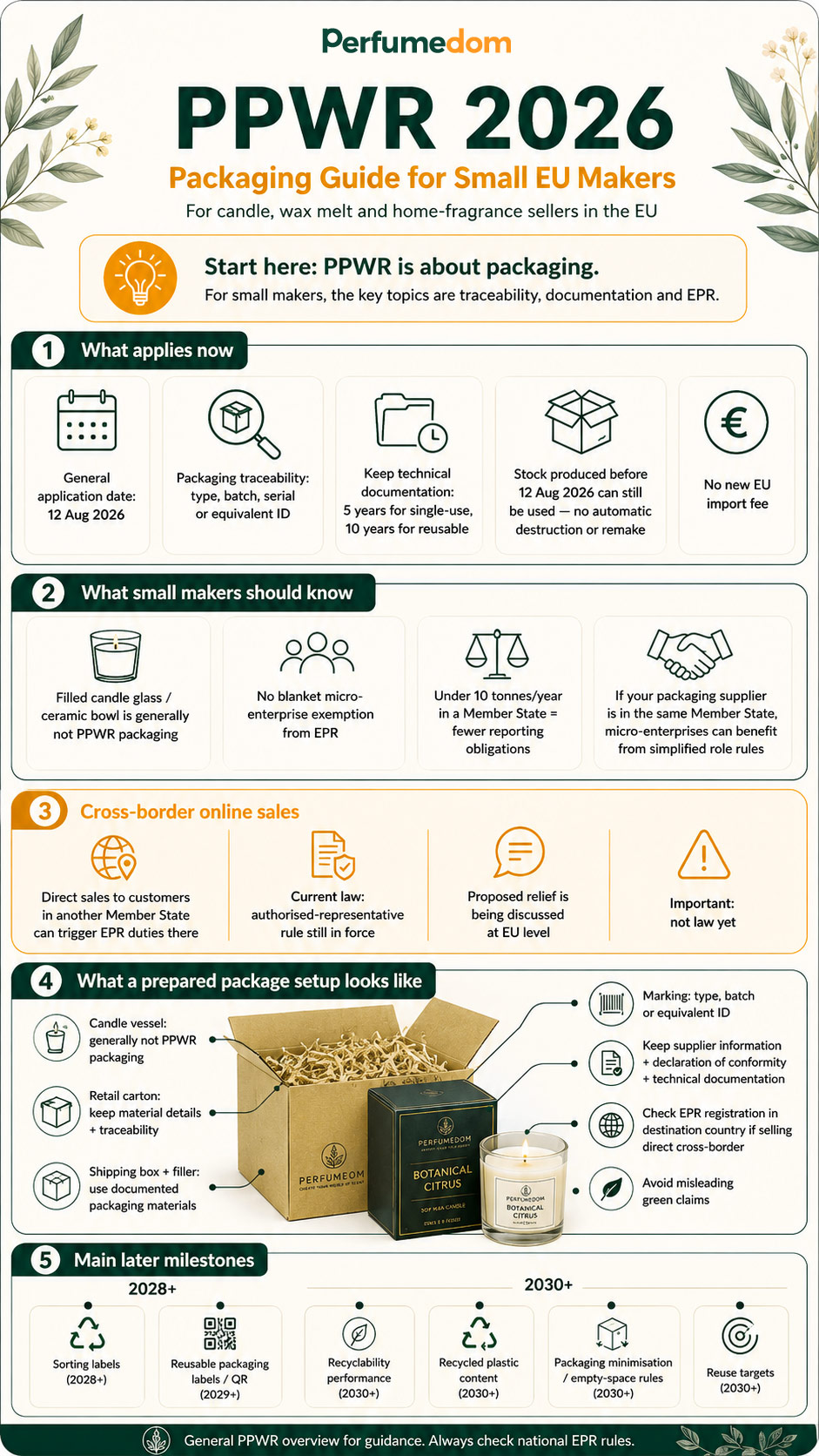
The infographic provides a quick visual summary of what applies now, what small makers should prepare, how cross-border EPR works and which major PPWR milestones come later.
How Perfumedom is already adapting
At Perfumedom, we are treating PPWR as a long-term packaging project rather than waiting until each future deadline arrives.
We have already moved our production sizes to aluminium packaging as part of that strategy. This should not be misunderstood as saying that PPWR requires aluminium! It does not. It is a packaging choice we have made while preparing our range for a market increasingly focused on recyclability, material efficiency and long-term packaging sustainability.
Approximately 90% of the packaging materials currently used by Perfumedom are recyclable, and we intend to continue improving this proportion wherever doing so remains technically and commercially sensible.
One area we are reviewing particularly carefully is our 10g PET tester bottle.
PET remains substantially more economical for a sample format, and there is no reason to create unnecessary cost for small makers merely for the appearance of being more sustainable.
We are therefore working with a packaging specialist consultant to determine how our tester packaging should evolve as the later PPWR plastic-packaging requirements become applicable.
Our current approach is straightforward:
if PET testers remain compliant, practical and appropriate under the applicable PPWR requirements, we intend to keep them.
If future requirements make the current PET format impractical or unsuitable, we can transition the tester range to 10g aluminium bottles. That option is technically available, but it would materially increase the cost of those small formats.
Our objective is therefore not to replace packaging simply because a different material sounds greener. It is to choose packaging that is legally compliant, recyclable, technically appropriate and economically realistic.
What should a small maker do now?
You do not need to redesign your entire packaging system this week.
A more sensible approach is to start building a clear record of what packaging you actually use.
Know who supplies your retail cartons, bottles or jars, closures, shipping boxes and fillers. Keep the technical or material information your supplier provides. Make sure packaging for which you are responsible can be linked to an identifiable type or batch. Review whether your shipping packaging is unnecessarily large. And, most importantly, understand where you may already have EPR obligations when selling directly to consumers in another Member State.
When replacing packaging or developing a new range, it now makes sense to consider the 2030 direction of the PPWR rather than selecting a format that may have to be redesigned again in only a few years.
That is preparation. It is very different from panic.
What Perfumedom will continue doing
Perfumedom will continue monitoring both the PPWR itself and the implementing and delegated legislation that will determine many of the detailed rules still to come.
We will pay particular attention to cross-border EPR, the authorised-representative proposal, packaging labelling, recyclability criteria, recycled-content methodology and packaging-minimisation rules.
When a meaningful regulatory change actually occurs, our customer updates will distinguish clearly between:
what is already law, what has been adopted but applies later, and what is merely being proposed or discussed.
Our goal is simple: you should be able to focus on creating and selling products without having to decode 100 pages of EU packaging legislation every time a headline appears.
Keynotes (TL;DR)
- EU Packaging Rules under PPWR generally apply from 12 August 2026, but many major requirements phase in later.
- Filled candle glasses and ceramic candle bowls have a specific Commission clarification that they are not PPWR packaging.
- Do not assume that the same exemption automatically applies to cosmetic jars, ordinary bottles or reed-diffuser bottles.
- Packaging traceability and documentation are already relevant where you are the responsible PPWR manufacturer.
- Packaging already produced before 12 August 2026 does not automatically have to be destroyed or remade.
- Businesses below 10 tonnes of packaging per Member State receive reduced reporting obligations, but there is no universal small-business EPR exemption.
- Cross-border direct-to-consumer sales can create EPR obligations in the customer’s Member State.
- EPR is a packaging waste contribution, not an EU customs or import fee.
- The cross-border authorised-representative requirement is currently still law. Proposed relief for EU businesses has not yet been adopted.
- Major recyclability, recycled-content, minimisation and empty-space requirements are principally 2030-era obligations.
- PPWR does not require businesses to switch to aluminium or ban PET as a material outright.
- Perfumedom will continue monitoring the rules and translating actual regulatory changes into practical actions for customers.
Further reading
- Regulation (EU) 2025/40: Full PPWR legal text
https://eur-lex.europa.eu/eli/reg/2025/40/oj/eng - European Commission: PPWR overview
https://environment.ec.europa.eu/topics/waste-and-recycling/packaging-waste/packaging-packaging-waste-regulation_en - European Commission: PPWR Frequently Asked Questions
https://environment.ec.europa.eu/publications/faq-packaging-and-packaging-waste-regulation-ppwr_en - European Commission: official PPWR Guidance Document
https://eur-lex.europa.eu/legal-content/EN/TXT/?uri=intcom%3AC%282026%293702
This article provides general regulatory information and does not replace advice regarding the national EPR or packaging requirements applicable to a particular business or Member State.




Write a comment
Your email address will not be published. All fields are required