
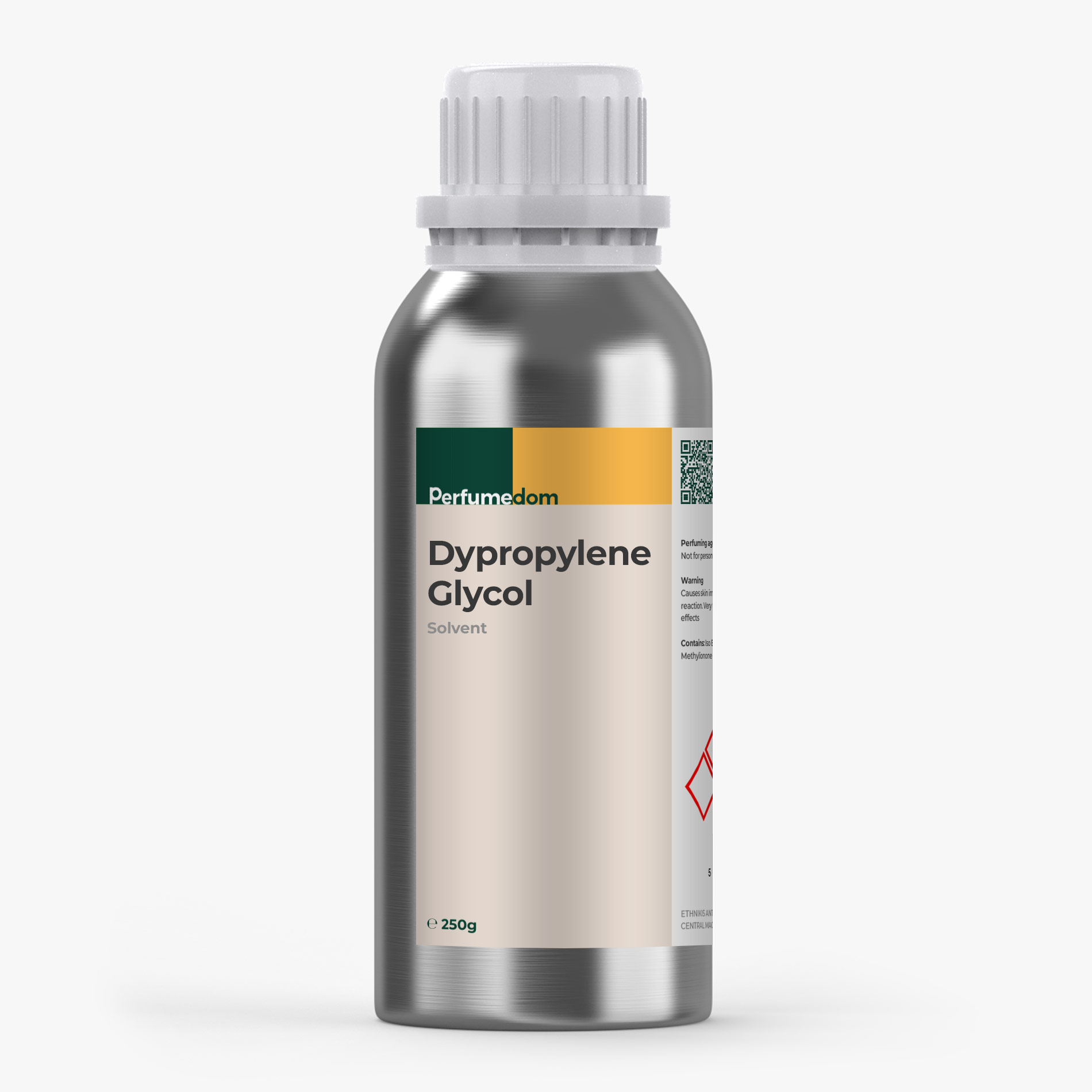

Dipropylene Glycol DPG
DPG is not used to create a scent impression by itself. Its value is practical: it helps formulators handle strong, crystalline, powdery, or difficult-to-dose materials more accurately. Unlike fast-evaporating alcohol, DPG stays in the formula and can slow the release of volatile materials, which makes it useful in perfume oils, roll-on style products, fragrance concentrates, and laboratory dilutions. It should still be tested carefully, because too much DPG can affect evaporation, diffusion, viscosity, wax performance, and diffuser compatibility.
- Main impression: Neutral solvent
- Supporting facets: Practically odourless, faintly technical, low volatility
- Drydown character: Slow, soft, neutral, non-perfumey
- Used for: Dilution, dosing accuracy, solvent support, non-alcoholic bases, controlled release
Please note
Dipropylene Glycol is a raw perfumery solvent, not a finished perfume or fragrance oil. It is intended for formulation work and must not be applied directly as a finished cosmetic product unless used within a properly assessed final formula.
Solvents and diluents may behave differently depending on dosage, fragrance composition, wax, diffuser base, cosmetic base, temperature, packaging, and the intended application. Always test in your final product before production.
Full safety, IFRA, cosmetic, and technical information is provided in the SDS, IFRA Certificate, and Allergen Declaration available in the “Related Documents” tab. Compliance of the final product is the responsibility of the manufacturer.
Packaging note: 10g sizes are supplied in PET bottles for affordable small-quantity access. Production sizes from 50g upwards are supplied in premium aluminium bottles for improved long-term protection. Read more
Olfactive Profile
- Primary character: Practically odourless neutral solvent.
- Secondary nuances: Very faint technical sweetness may be detectable at high levels.
- Texture: Smooth, viscous, slow-moving, and low-volatility.
- Diffusion: Does not add diffusion; it may slow evaporation depending on dosage.
- Tenacity: Remains in the formula longer than fast-evaporating alcohols.
- Comparison anchor: Less volatile than ethanol, more neutral than many oil carriers, and more functional than olfactive.
DPG does not smell like a perfume ingredient in the usual sense. It is used as a quiet carrier that helps strong materials become easier to measure, blend, and evaluate. In small amounts, it should stay mostly invisible. In larger amounts, it can make a formula feel slower, softer, heavier, or less diffusive, which is why application testing is essential.
Formulation & Creative Uses
What It Adds to Your Formula
- Dilution control: Makes strong materials easier to dose accurately.
- Handling ease: Helps dissolve or dilute crystals, powders, and high-impact materials.
- Slower evaporation: Reduces the quick flash-off associated with alcohol-based trials.
- Formula softness: Can make harsh or very sharp materials easier to evaluate.
- Carrier function: Supports oil-based perfume concentrates and non-alcoholic trial blends.
- Practical consistency: Helps create repeatable dilutions for small-scale formulation work.
What It Does Not Do
- It does not add a fragrance note: It is a solvent, not an olfactive building block.
- It does not replace every carrier: Compatibility depends on the end product and formulation system.
- It does not guarantee solubility: Some materials still need testing or a different solvent system.
- It is not a complete reed diffuser base: It can be part of a system, but on its own it may be too slow or heavy.
- It is not ideal for every device: Cold-air diffusers, nebulizers, and ultrasonic systems require specific compatibility testing.
Creative Uses
Dypropylene Glycol is excellent for preparing working dilutions of powerful aroma molecules, especially materials where direct weighing is difficult. It is useful for trial solutions of sweeteners, lactones, powders, crystals, musks, and high-impact fruity materials. It can also help create non-alcoholic perfume oil trials, controlled lab blends, and easier-to-handle versions of materials that would otherwise dominate a formula in tiny amounts.
Creative Inspiration
Use DPG to prepare a 10% Vanillin dilution for easier gourmand trials. Use it with Ethyl Maltol or Coumarin when small direct doses are too difficult to control. Prepare 1–10% dilutions of strong fruity materials like C16 Aldehyde or Gamma Decalactone for more accurate testing. Use it as a neutral carrier when comparing how different musks, lactones, or sweet materials behave in the same base.
Common Applications
- Perfumery trials: Useful for preparing controlled dilutions of strong or difficult-to-weigh materials.
- Perfume oils: Can act as a slow-evaporating carrier in non-alcoholic fragrance formats, subject to final safety assessment.
- Candles & wax melts: Can appear as a solvent in fragrance concentrates, but high levels may affect wax compatibility and burn performance.
- Reed diffusers: May help dissolve fragrance materials, but is not a complete diffuser base by itself.
- Room sprays: Can be used only where compatible with the solvent system; excessive levels may affect clarity or spray feel.
- Cosmetic fragrance bases: Suitable where permitted by IFRA, formula compatibility, and final product safety assessment.
Usage, Dose & Performance
- Suggested working dilution: 10% is a practical starting dilution for many strong aroma materials.
- Low use: Helps with small corrections, trace additions, and easier weighing.
- Moderate use: Can act as a practical carrier for perfume oil trials and concentrated lab blends.
- High use: May slow evaporation, reduce lift, increase viscosity, or make a formula feel heavier.
- Diffusion effect: Usually neutral to muting; it does not boost projection.
- Solvent behavior: Useful with many fragrance materials, but not universal.
- Compatibility: Must be checked in wax, reed bases, spray systems, cosmetic bases, and device-specific diffuser systems.
- Overuse risk: Too much DPG can make a blend feel flat, slow, oily, or less expressive.
Practical Pairing & Dilution Uses
Useful with aroma molecules
- Vanillin: Helps prepare easier-to-dose vanilla dilutions.
- Ethyl Maltol: Makes very small sweetener additions more controlled.
- Coumarin: Supports smoother handling of powder dilutions.
- C16 Aldehyde: Helps control strong fruity-strawberry effects.
- Gamma Decalactone: Makes creamy lactonic fruit additions easier to measure.
- Cashmeran: Useful for controlled trials in musky-powdery bases.
Useful with essential oils
- Clove Bud Essential Oil: Helps reduce dosing intensity in spicy trials.
- Lemongrass Essential Oil: Softens very sharp citrus-herbal additions.
- Peppermint Essential Oil: Makes strong mint additions easier to control.
- Citronella Essential Oil: Helps manage powerful green-citrus intensity.
- Black Pepper Essential Oil: Useful for controlled spicy dosage trials.
- Ginger Essential Oil: Helps test fresh spicy warmth in smaller increments.
Useful with base accords
- Vanilla Accord: Helps prepare sweet gourmand trials with better dosage control.
- White Musk Accord: Supports soft perfume oil and clean musk experiments.
- Amber Accord: Useful for warm non-alcoholic amber trials.
- Rice Accord: Helps create soft milky comfort tests.
- Sandal Accord: Supports smooth woody oil-based trials.
- Tobacco Black Accord: Helps manage heavier warm base structures.
Technical Data & IFRA Limits
- Commercial name: Dipropylene Glycol
- Synonyms: DPG, Oxydipropanol, 1,1′-Oxydipropan-2-ol
- INCI name: Dipropylene Glycol
- IUPAC name: 1,1′-Oxydipropan-2-ol
- CAS number: 25265-71-8
- EC number: 246-770-3
- Chemical class: Glycol solvent
- Material form: Liquid
- Flash point: 138°C
- Solubility: Soluble in alcohol; soluble in water
- Allergen declaration: No listed EU fragrance allergens declared.
IFRA 51st Amendment Limits
- Fine fragrance: < 100%
- Body creams, oils and lotions: < 100%
- Soap and rinse-off products: < 100%
- Reed diffusers: < 100%
- Room sprays: < 100%
- Candles: < 100%
The supplied IFRA certificate also lists 0% for lip products and toothpaste/oral-care applications, so DPG should not be used in those categories based on the supplied documentation. IFRA percentages are maximum permitted levels, not recommended usage levels. The final product manufacturer is responsible for checking the correct IFRA category, calculating the final concentration, and confirming suitability in the intended application.
Stability & Handling
Dipropylene Glycol should be stored tightly sealed in a cool, dry, well-ventilated area, away from heat, ignition sources, high temperatures, and UV exposure. It is supplied as a colourless liquid and does not require pre-warming before use. It is compatible with common storage materials such as steel, stainless steel, plastic, and aluminium containers according to the supplier documentation. Its discoloration potential is considered very low because the material is colourless and not used for its own olfactive colour or character. Testing is still recommended in clear products, pale waxes, sprays, and device-specific applications because DPG can affect viscosity, evaporation, clarity, and performance.
Safety & Testing
Dipropylene Glycol is a raw perfumery solvent for formulation use. It is not a finished perfume, fragrance oil, cosmetic product, or diffuser base by itself.
Always review the SDS, IFRA Certificate, Cosmetics Declaration, and Technical Data Sheet before use. Test the material in the intended base before production, as performance may vary depending on dosage, fragrance composition, wax type, diffuser base, spray solvent, cosmetic base, processing temperature, and packaging.
Final product safety, labelling, IFRA compliance, CLP classification, cosmetic assessment, allergen declaration, and market compliance remain the responsibility of the final product manufacturer.
Why Choose Perfumedom
⚡ Swift Response Times
With a 97% stock uptime and our efficient order fulfillment system, your fragrance oils are delivered promptly, ensuring you meet your production timelines.
⭐ Consistent Performance
Our fragrance oils are sourced from established European manufacturers and designed for professional use, offering consistency and performance in every batch.
🛡️ Commitment to Safety
Every fragrance in our assortment is supported by up-to-date SDS, IFRA, and CLP guidance, and manufactured strictly only with REACH regulated substances.
Reviews
There are no reviews yet